Software teams need to release applications faster without compromising security, reliability, or performance. Yet manual deployments, inconsistent infrastructure, growing cloud costs, and complex development workflows can make these goals difficult to achieve.
Modern DevOps practices help organizations address these challenges through automation, collaboration, continuous testing, and better operational visibility.
The latest DevOps trends focus on AI-assisted operations, DevSecOps, GitOps, platform engineering, Infrastructure as Code, observability, and cloud cost optimization. These approaches are changing how businesses build, deploy, monitor, and maintain software.
Understanding these trends can help engineering leaders decide which technologies are worth adopting and where process improvements will deliver the most value.
This guide explores ten important DevOps trends, their practical applications, implementation challenges, and how
DevOps consulting services can help businesses modernize their software delivery workflows.
Key Takeaways
- AI-assisted DevOps: Use AI to support incident analysis, anomaly detection, testing, and selected repetitive tasks.
- DevSecOps: Integrate security checks into development and deployment workflows.
- GitOps: Manage application and infrastructure configurations through version-controlled repositories.
- Platform engineering: Provide developers with reusable templates, approved workflows, and self-service infrastructure.
- Cloud-native architecture: Evaluate containers, Kubernetes, and serverless computing according to application requirements.
- Infrastructure as Code: Create repeatable infrastructure configurations using version-controlled definitions.
- Observability: Combine logs, metrics, and traces to investigate application behavior and production issues.
- FinOps: Improve visibility into cloud spending and make informed infrastructure decisions.
- CI/CD automation: Build reliable pipelines that automate testing and software delivery.
- Hybrid and multi-cloud operations: Standardize workflows while accounting for differences between infrastructure environments.
What Is DevOps and Why Does It Matter?
DevOps is a combination of cultural practices, processes, and technologies that brings software development and IT operations closer together.
Its primary goal is to improve software delivery through collaboration, automation, continuous feedback, and reliable operational practices.
For example, a team that manually tests and deploys every application update may experience inconsistent releases and avoidable delays. An automated continuous integration and continuous delivery (CI/CD) pipeline can run tests, validate changes, and deploy approved code through a repeatable process.
DevOps can help organizations:
- Improve software delivery speed.
- Reduce errors caused by repetitive manual work.
- Standardize development and production environments.
- Identify and investigate incidents more effectively.
- Integrate security into the development lifecycle.
- Improve collaboration between engineering and operations teams.
- Monitor application performance and infrastructure costs.
However, adopting
DevOps tools alone does not guarantee better results. Organizations also need suitable processes, clear ownership, appropriate security controls, and measurable objectives.
What Are the Latest DevOps Trends?
The major areas shaping modern DevOps include AI-assisted operations, DevSecOps, GitOps, platform engineering, cloud-native architecture, Infrastructure as Code, observability, FinOps, CI/CD automation, and hybrid or multi-cloud operations.
The following table summarizes these trends and their practical business applications.
| DevOps trend |
Main application |
Potential business benefit |
Example tools |
| AI-assisted DevOps and AIOps |
Incident analysis and anomaly detection |
Faster investigation of operational problems |
Dynatrace, Datadog |
| DevSecOps |
Security checks throughout development |
Earlier identification of vulnerabilities |
SonarQube, Snyk, Trivy |
| GitOps |
Version-controlled deployment management |
Improved consistency and traceability |
Argo CD, Flux |
| Platform engineering |
Reusable developer workflows |
Less repetitive infrastructure work |
Backstage, Humanitec |
| Cloud-native and serverless |
Application deployment and scaling |
Architecture suited to specific workload needs |
Docker, Kubernetes, Azure Functions |
| Infrastructure as Code |
Automated infrastructure provisioning |
Repeatable environments |
Terraform, OpenTofu, Azure Bicep |
| Observability and AIOps |
Analysis of logs, metrics, and traces |
Better incident investigation |
OpenTelemetry, Prometheus, Grafana |
| FinOps |
Cloud cost visibility and optimization |
More informed spending decisions |
Azure Cost Management, Kubecost |
| CI/CD and test automation |
Automated build, test, and deployment workflows |
Faster feedback and more consistent releases |
Azure Pipelines, GitHub Actions, Jenkins |
| Hybrid and multi-cloud operations |
Consistent management across environments |
Better operational coordination |
Terraform, Azure Arc |
These tools serve different purposes, and the list is illustrative rather than a ranking. The right selection depends on existing infrastructure, application requirements, team expertise, and budget.
1. AI and Machine Learning Adoption in DevOps
AI and machine learning (ML) are transforming DevOps by helping teams analyze operational data, detect anomalies, automate repetitive tasks, and improve incident management.
How AI and ML Are Used in DevOps
- Predictive Analysis: Identify patterns in historical data to help anticipate potential system issues.
- Anomaly Detection: Detect unusual changes in application performance, error rates, and resource usage.
- Intelligent Log Analysis: Analyze logs and identify patterns that help engineers investigate problems.
- Automated Testing: Assist with test case generation and test failure analysis.
- Incident Management: Correlate alerts and recommend possible solutions to operational issues.
- Deployment Risk Analysis: Analyze historical deployment data to help identify potential release risks.
How to Adopt AI and ML in DevOps
Businesses can begin AI/ML adoption by following these steps:
- Identify Use Cases: Select a specific problem, such as excessive alerts or slow incident investigations.
- Assess Data Quality: Ensure monitoring data and logs are relevant and reliable.
- Choose Suitable Tools: Select tools that integrate with your existing DevOps environment.
- Run a Pilot: Test the solution on a small scale before expanding its use.
- Measure Results: Evaluate improvements in incident response, alert quality, or operational efficiency.
Challenges of AI/ML Adoption
Businesses should consider data quality, integration complexity, security, cost, and inaccurate predictions. AI-generated recommendations should be validated before critical production changes are implemented.
With the right approach,
AI and ML can complement DevOps automation and help teams manage software delivery more efficiently.
2. DevSecOps: Integrating Security into Software Delivery
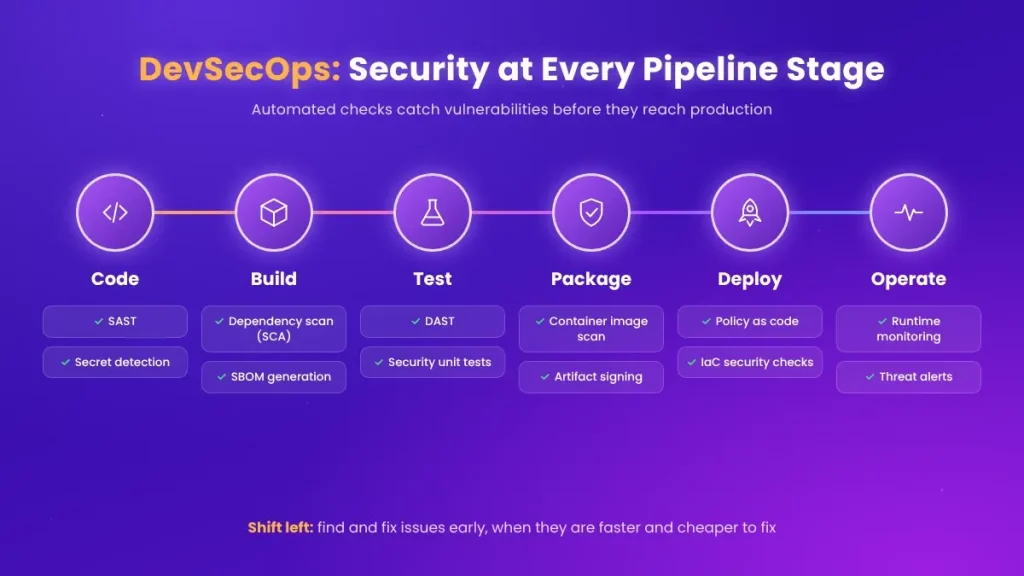
DevSecOps integrates security into development, testing, deployment, and operations instead of treating it as a final checkpoint before release.
This approach helps teams identify and address security issues earlier in the software development lifecycle.
Important DevSecOps Practices
- Static application security testing (SAST): Analyzes source code for certain categories of security weaknesses.
- Software composition analysis (SCA): Identifies known vulnerabilities in third-party dependencies.
- Secret detection: Helps detect exposed credentials, API keys, and other sensitive values.
- Container security: Scans container images for vulnerable packages and configuration issues.
- Infrastructure security checks: Evaluates infrastructure definitions against established security policies.
- Dynamic application security testing (DAST): Tests running applications for certain vulnerabilities.
These checks can be integrated into CI/CD pipelines so developers receive feedback before changes reach production.
Why DevSecOps Matters
Security integration can reduce the risk of known vulnerabilities passing through the delivery process unnoticed.
However, adding too many blocking checks without prioritization can slow releases and create alert fatigue.
Teams should define clear policies for critical findings, establish exception procedures, and ensure that security results are actionable.
Businesses using Microsoft's development ecosystem can integrate appropriate security tools into Azure Pipelines according to their application architecture and compliance requirements.
3. GitOps for Consistent Deployments
GitOps uses Git repositories as the source of truth for declarative infrastructure configurations and application deployments.
Teams store configuration changes in version control, review them through an established process, and use automation to apply approved changes.
GitOps is particularly useful in Kubernetes environments, where controllers can compare the desired system state with the actual state and reconcile differences.
Key Benefits of GitOps
- Version control: Track configuration changes and review their history.
- Consistency: Apply approved configurations across suitable environments.
- Traceability: Use commits and pull requests to understand changes.
- Drift detection: Identify differences between declared and actual configurations.
- Recovery: Restore a known configuration when appropriate.
For example, an organization managing several Kubernetes environments may experience inconsistencies caused by manual configuration changes.
With GitOps, the team can maintain the desired configurations in a repository and use an automated controller to reconcile the environments.
This reduces reliance on undocumented manual changes.
GitOps does not replace CI/CD. Testing, artifact management, access controls, monitoring, and deployment safeguards remain essential.
4. Platform Engineering and Internal Developer Platforms
Platform engineering focuses on creating reusable infrastructure capabilities and development workflows that help engineers build and deploy applications more consistently.
An internal developer platform can provide approved templates, self-service infrastructure, standardized CI/CD pipelines, documentation, and built-in security controls.
How Platform Engineering Helps
Without standardized workflows, developers may need to request infrastructure manually or configure every project independently.
A well-designed internal platform can provide:
- Reusable application templates.
- Standardized deployment pipelines.
- Self-service infrastructure provisioning.
- Approved security and compliance checks.
- Centralized documentation.
- Consistent monitoring and operational practices.
For example, a developer launching a new application could start with an approved template that already includes a deployment pipeline and monitoring configuration.
This reduces repetitive setup work and encourages consistent engineering practices.
What to Consider Before Adopting Platform Engineering
An internal developer platform requires ownership, maintenance, documentation, and feedback from the teams using it.
Avoid creating a complex platform that developers find difficult to use.
Start with recurring engineering problems, introduce reusable capabilities gradually, and measure adoption and developer satisfaction.
5. Cloud-Native Architecture, Kubernetes, and Serverless Computing
Cloud-native architecture uses technologies and practices designed to help applications run, scale, and recover in cloud environments.
Containers, orchestration, automated deployment, and observability are common components of cloud-native systems.
Containers and Kubernetes
Containers package an application and its dependencies into a consistent runtime environment.
Docker is commonly used to build and run containers, while Kubernetes orchestrates containerized workloads across clusters.
Kubernetes can help manage:
- Application deployment and scaling.
- Workload scheduling.
- Service discovery and networking.
- Health checks and workload recovery.
- Configuration and secrets integrations.
However, Kubernetes introduces operational responsibilities, including cluster upgrades, access management, networking, monitoring, and resource allocation.
It may be suitable for organizations operating many containerized services or requiring orchestration across multiple environments. A smaller application may be easier to manage using a managed application platform.
Serverless Computing
Serverless platforms allow developers to run functions or applications without directly managing the underlying server infrastructure.
Examples include Azure Functions and AWS Lambda.
Serverless computing can suit event-driven processing, scheduled tasks, lightweight APIs, and workloads with variable demand.
Before adopting it, evaluate execution limits, monitoring, pricing, vendor dependencies, and workload requirements.
Cloud-native and serverless approaches are complementary options rather than universal replacements for one another.
6. Infrastructure as Code and Cloud Automation
Infrastructure as Code (IaC) allows teams to define infrastructure through machine-readable configuration files instead of relying entirely on manual provisioning.
Tools such as Terraform, OpenTofu, and Azure Bicep can support infrastructure automation in suitable environments.
Why Infrastructure as Code Matters
IaC helps teams:
- Create repeatable environments.
- Review infrastructure changes before applying them.
- Reduce configuration inconsistencies.
- Track infrastructure definitions in version control.
- Automate provisioning and teardown.
- Document infrastructure configurations.
For example, a team can define networking, compute resources, and other cloud components in configuration files. A CI/CD pipeline can validate proposed changes before they are applied.
Infrastructure Automation Best Practices
Use reusable modules, consistent naming conventions, secure state storage, and appropriate access controls.
Protect sensitive values and review infrastructure plans before making changes.
Organizations can also apply policy-as-code practices to enforce requirements such as approved resource types or storage security settings.
Infrastructure automation makes governance more repeatable, but it does not eliminate the need for security reviews and operational oversight.
7. Observability and AIOps
Observability helps teams understand what is happening inside an application or distributed system by analyzing its outputs.
The three main observability signals are logs, metrics, and traces.
Logs record events generated by applications and infrastructure.
Metrics provide numerical measurements such as request latency, CPU utilization, error rates, and throughput.
Traces show how requests move across services, helping engineers identify delays and failures.
When these signals are correlated, teams can investigate production issues more effectively.
For example, an increase in API response time might originate from a database, a resource constraint, or a downstream service.
Traces can help identify the affected component, while logs and metrics provide additional evidence.
AIOps tools can assist with anomaly detection and alert correlation, but their effectiveness depends on useful telemetry and appropriate configuration.
Businesses should focus on actionable alerts, service-level objectives, and clear incident response procedures.
8. FinOps and Cloud Cost Optimization
FinOps brings financial accountability into cloud operations so teams can understand and manage infrastructure spending.
As cloud environments grow, costs can become difficult to attribute to individual applications, teams, or workloads.
FinOps practices help organizations:
- Identify underused resources.
- Monitor spending against budgets.
- Attribute costs to applications or business units.
- Evaluate the financial impact of architecture decisions.
- Optimize resource allocation.
- Identify unnecessary infrastructure usage.
For example, a company may discover that development environments continue running outside working hours despite having no active users.
The team can assess whether scheduled shutdowns are appropriate for those environments.
Balancing Cost and Reliability
Cloud cost optimization should not compromise security, availability, or performance.
A configuration that reduces spending but creates more outages or maintenance work may not deliver an overall benefit.
Regular reviews, clear resource ownership, and reliable cost reporting help teams make informed decisions.
9. CI/CD and Automated Testing
Continuous integration and continuous delivery or deployment automate the process of building, testing, and delivering software.
CI/CD pipelines provide repeatable workflows and faster feedback when code changes introduce problems.
Important CI/CD Practices
- Automated unit and integration testing.
- Build validation and artifact management.
- Dependency and security scanning.
- Deployment approvals where appropriate.
- Automated deployment to suitable environments.
- Post-deployment health checks.
- Rollback and recovery procedures.
Tools such as Azure Pipelines, GitHub Actions, and Jenkins can support CI/CD workflows.
How to Improve a CI/CD Pipeline
Start by identifying where delays and failures occur.
Common bottlenecks include slow builds, unreliable tests, manual deployment steps, and inconsistent environments.
Then prioritize improvements based on their likely impact.
For example, caching dependencies may help slow builds, while standardized infrastructure may address environment-related failures.
Teams can also track software delivery metrics such as deployment frequency, lead time for changes, change failure rate, and time to restore service.
The objective is not to automate every step indiscriminately. It is to build a reliable delivery process that balances speed, quality, security, and operational control.
10. Hybrid and Multi-Cloud DevOps
Some organizations operate across multiple cloud providers or combine public cloud infrastructure with private infrastructure and on-premises systems.
These environments may support regulatory requirements, existing technology investments, regional needs, or particular workload requirements.
However, hybrid and multi-cloud operations can introduce additional complexity.
Teams may need to coordinate different identity systems, monitoring tools, networking models, deployment processes, and cost structures.
Best Practices for Hybrid and Multi-Cloud Operations
- Standardize deployment workflows where practical.
- Apply consistent access controls and security policies.
- Use Infrastructure as Code where appropriate.
- Centralize relevant logging and monitoring.
- Establish clear cloud cost ownership.
- Document dependencies between systems and providers.
- Evaluate portability requirements before choosing technologies.
Using multiple clouds does not automatically improve resilience or reduce costs.
A multi-cloud strategy should have a clear business or technical justification and the operational expertise needed to manage it.
How DevOps Consulting Services Help Businesses Adopt These Trends
Understanding DevOps trends is only the first step. Organizations must determine which practices fit their applications, infrastructure, development workflows, and business goals.
DevOps consulting services can help businesses assess their current environment, identify bottlenecks, and establish a practical improvement roadmap.
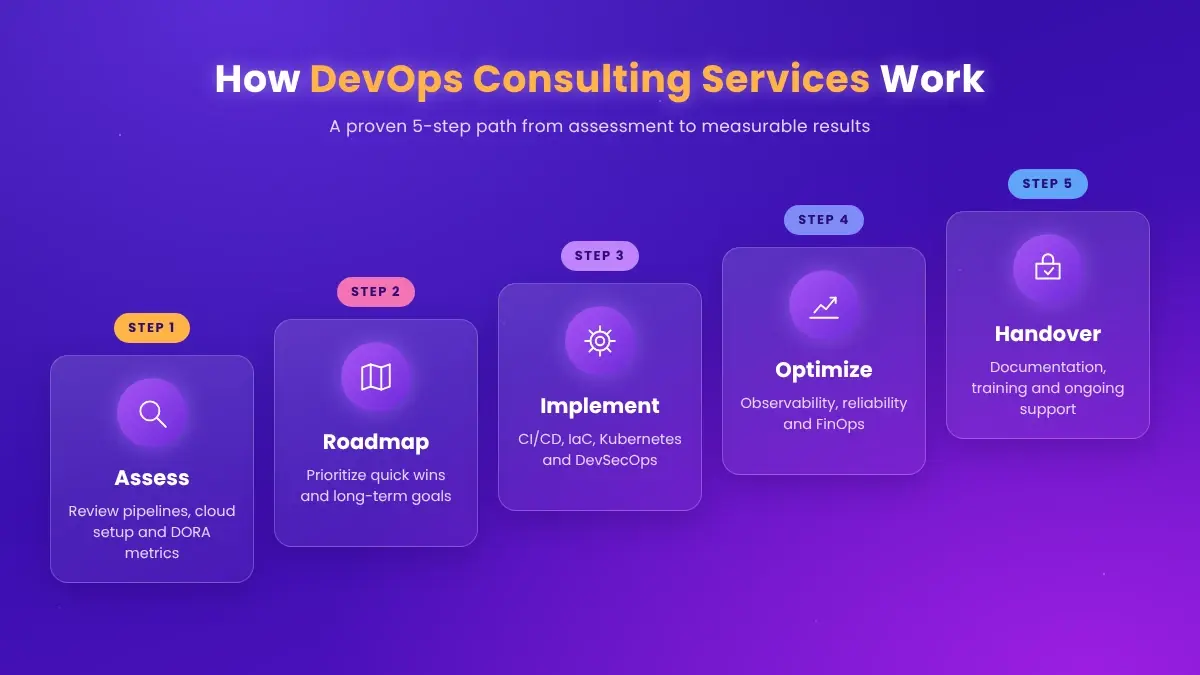
Depending on the project, DevOps services may include the following.
1. CI/CD Pipeline Implementation
Consultants can assess existing build and deployment workflows, identify manual steps, and design automated pipelines with appropriate testing and deployment controls.
2. Cloud Infrastructure Automation
Infrastructure automation helps teams create consistent environments and reduce repetitive provisioning work. The implementation should reflect the organization's cloud platform and operational requirements.
3. Azure DevOps Consulting Services
Businesses using Microsoft's development ecosystem may need support configuring Azure Repos, Azure Pipelines, automated testing, release workflows, and deployment environments.
The objective is to create maintainable workflows that support the organization's engineering and operational needs.
4. DevSecOps Implementation
DevSecOps implementation can include code analysis, dependency scanning, secret detection, container scanning, and infrastructure security checks.
The scope should reflect the organization's risk profile and compliance requirements.
5. Monitoring and Operational Improvement
Consultants can help teams assess monitoring coverage, improve alert quality, define operational metrics, and strengthen incident investigation procedures.
6. Cloud Cost Optimization
Cloud infrastructure reviews can identify opportunities to improve resource utilization, remove unnecessary resources, and increase visibility into spending.
A suitable roadmap should prioritize measurable improvements rather than introducing tools simply because they are popular.
When Should You Hire a DevOps Consulting Company?
Hiring a DevOps consulting company may be useful when internal teams need specialized expertise or face recurring software delivery and infrastructure problems.
Consider external support when:
- Software releases depend on slow manual processes.
- CI/CD pipelines are unreliable or difficult to maintain.
- Cloud infrastructure is configured inconsistently.
- Production incidents take too long to investigate.
- Security checks are missing from delivery workflows.
- Cloud costs are increasing without clear visibility.
- Your team needs assistance with Azure DevOps or infrastructure automation.
Before hiring a provider, define the problems you want to solve, the systems involved, and the outcomes you expect.
Agree on responsibilities, documentation, knowledge transfer, and ongoing ownership before implementation begins.
How to Choose the Right DevOps Service Provider
Selecting among DevOps service providers requires more than comparing prices or technology lists.
Evaluate the provider's technical expertise, implementation approach, and ability to support the solution after deployment.
Consider these seven factors:
1. Technical expertise: Look for relevant experience with your cloud platforms, CI/CD tools, and application architecture.
2. Implementation experience: Request genuine case studies and examples of comparable challenges.
3. Security practices: Understand how the provider handles access controls, secrets, vulnerability management, and secure deployments.
4. Infrastructure automation: Evaluate its approach to version control, reusable configurations, and change reviews.
5. Documentation and knowledge transfer: Ensure your team can understand and maintain the implemented solution.
6. Monitoring and support: Establish expectations for incident response, maintenance, and ongoing optimization.
7. Measurable outcomes: Agree on suitable measures, such as deployment frequency, change failure rate, recovery time, pipeline duration, or cloud spending.
A reliable DevOps services company should explain the trade-offs of its recommendations rather than simply promote a particular tool or architecture.
Why Choose Spiral Mantra for DevOps Consulting?
When evaluating a DevOps consulting partner, businesses should look for technical expertise, a clear implementation approach, and an understanding of their existing development and infrastructure challenges.
Spiral Mantra offers DevOps consulting services for organizations seeking support with software delivery, cloud infrastructure, automation, and related engineering requirements.
The appropriate approach depends on your current technology stack, security requirements, team capabilities, and business objectives.
Before starting a project, define the desired outcomes, implementation responsibilities, documentation requirements, and plans for ongoing maintenance.
Frequently Asked Questions (FAQ's)
Q1. What are the latest DevOps trends?
Important DevOps trends include AI-assisted operations, DevSecOps, GitOps, platform engineering, Infrastructure as Code, observability, FinOps, CI/CD automation, and hybrid or multi-cloud operations. Their value depends on an organization's infrastructure, technical maturity, security requirements, and business goals.
Q2. How is AI changing DevOps?
AI can help teams analyze logs, detect anomalies, summarize incidents, suggest tests, and investigate operational problems. Its effectiveness depends on data quality, suitable integrations, and appropriate safeguards. Human review remains important for high-impact changes and production remediation.
Q3. What is the difference between DevOps and DevSecOps?
DevOps brings development and operations together through collaboration and automation. DevSecOps incorporates security into those workflows through practices such as code analysis, dependency scanning, secret detection, and infrastructure security checks.
Q4. What are DevOps consulting services?
DevOps consulting services help organizations assess and improve software delivery, CI/CD pipelines, cloud infrastructure, automation, monitoring, and security integration. Depending on project requirements, the engagement may include implementation, optimization, documentation, and knowledge transfer.
Q5. How do GitOps and CI/CD work together?
CI/CD automates software building, testing, and delivery. GitOps uses version-controlled configurations and automated reconciliation to manage application deployments or infrastructure. Together, they can support repeatable delivery workflows with improved change traceability.
Q6. Which tools are commonly used for DevOps automation?
Common tools include Azure Pipelines, GitHub Actions, Jenkins, Terraform, OpenTofu, Docker, Kubernetes, Prometheus, and Grafana. The right combination depends on the organization's cloud platform, application architecture, team skills, and operational requirements.
Q7. When should a business hire a DevOps consulting company?
A business may benefit from consulting when releases are slow, deployments fail frequently, infrastructure is difficult to manage, cloud costs lack visibility, or internal teams need specialized expertise in CI/CD, cloud automation, security, or monitoring.
Q8. How do I choose the right DevOps service provider?
Evaluate technical expertise, relevant implementation experience, security practices, infrastructure automation, documentation, knowledge transfer, and ongoing support. Ask the provider how success will be measured and whether the proposed solution can be maintained by your team.
Q9. How do Azure DevOps consulting services help businesses?
Azure DevOps consulting services can help organizations configure and improve Azure Repos, Azure Pipelines, automated testing, release workflows, and deployment controls. The scope depends on the organization's existing Microsoft development ecosystem and project requirements.
Q10. How can DevOps help reduce cloud costs?
DevOps can support cloud cost optimization through infrastructure automation, resource monitoring, environment cleanup, capacity adjustments, and FinOps practices. The actual savings depend on the existing environment and the improvements implemented. Cost reduction should not compromise reliability or security.
Conclusion
Modern DevOps is about more than adopting the latest tools. AI-assisted operations, DevSecOps, GitOps, platform engineering, Infrastructure as Code, observability, and FinOps can help organizations improve software delivery when implemented with clear objectives and appropriate controls.
The best approach begins by identifying existing bottlenecks, prioritizing improvements, and measuring their impact.
Some businesses may need more reliable CI/CD pipelines. Others may benefit from cloud automation, better security integration, improved observability, or more effective infrastructure cost management.
Spiral Mantra's DevOps consulting services can help businesses evaluate their requirements and explore suitable technology solutions.