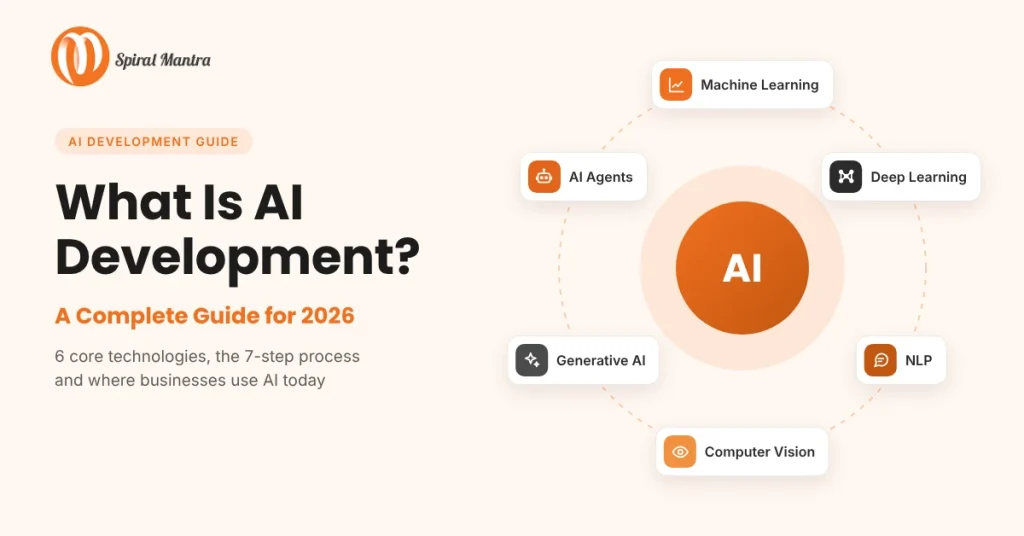
What is AI Development? Technologies, Process, and Applications
Artificial Intelligence (AI) is changing how businesses develop products, manage operations, analyze information, and interact with customers. From intelligent chatbots and predictive analytics to automated business workflows, AI is helping organizations solve problems that previously required significant manual effort.
However, adopting AI is not simply about integrating a chatbot or using an existing AI application. Businesses need to understand which problems AI can solve, what technologies are required, how solutions are developed, and how they can be integrated into existing systems.
This is where AI Development Services become important. They help businesses design, develop, integrate, and maintain intelligent applications based on their specific requirements.
For example, a retail company may use AI to forecast product demand, while a financial organization may implement machine learning to identify suspicious transactions. Similarly, an enterprise may develop an AI-powered knowledge assistant that helps employees find information across internal documents.
But how does AI development actually work? Which technologies are involved? And how can businesses decide whether they need custom AI development or an existing AI solution?
This guide explains AI development in simple language, covering its technologies, development process, business applications, costs, benefits, and future opportunities.
The information is particularly useful for business owners, CTOs, product leaders, IT managers, and enterprise technology teams planning their AI initiatives.
Both approaches are important. Many modern business applications combine traditional software engineering with AI capabilities.
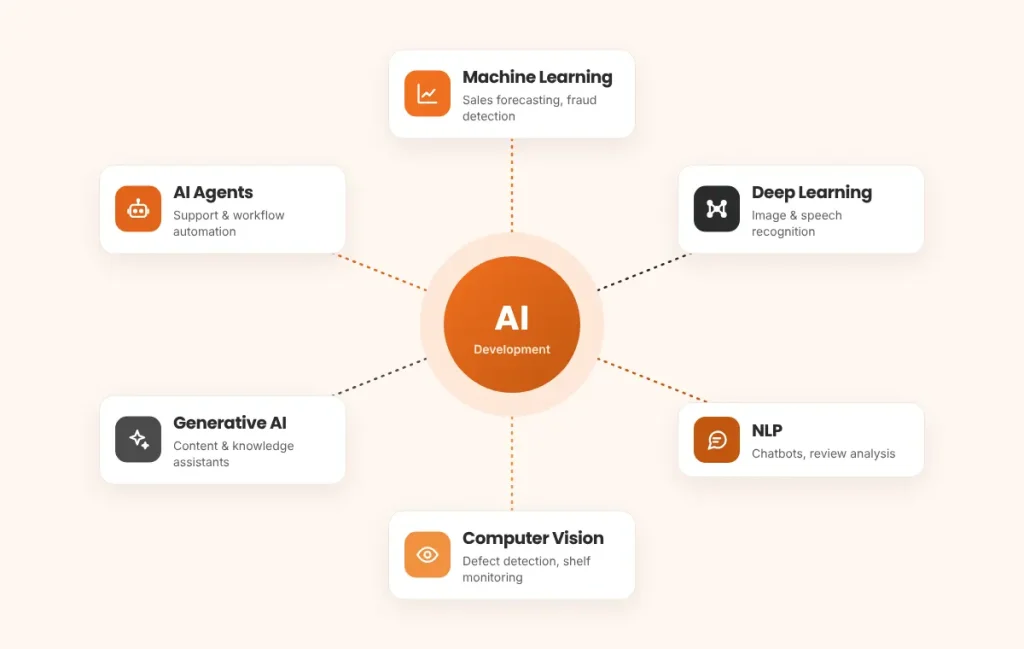 The following six technologies are commonly used in modern AI applications.
Not every business problem requires a complex AI model. Sometimes, traditional automation or an existing AI API is a more practical and cost-effective choice.
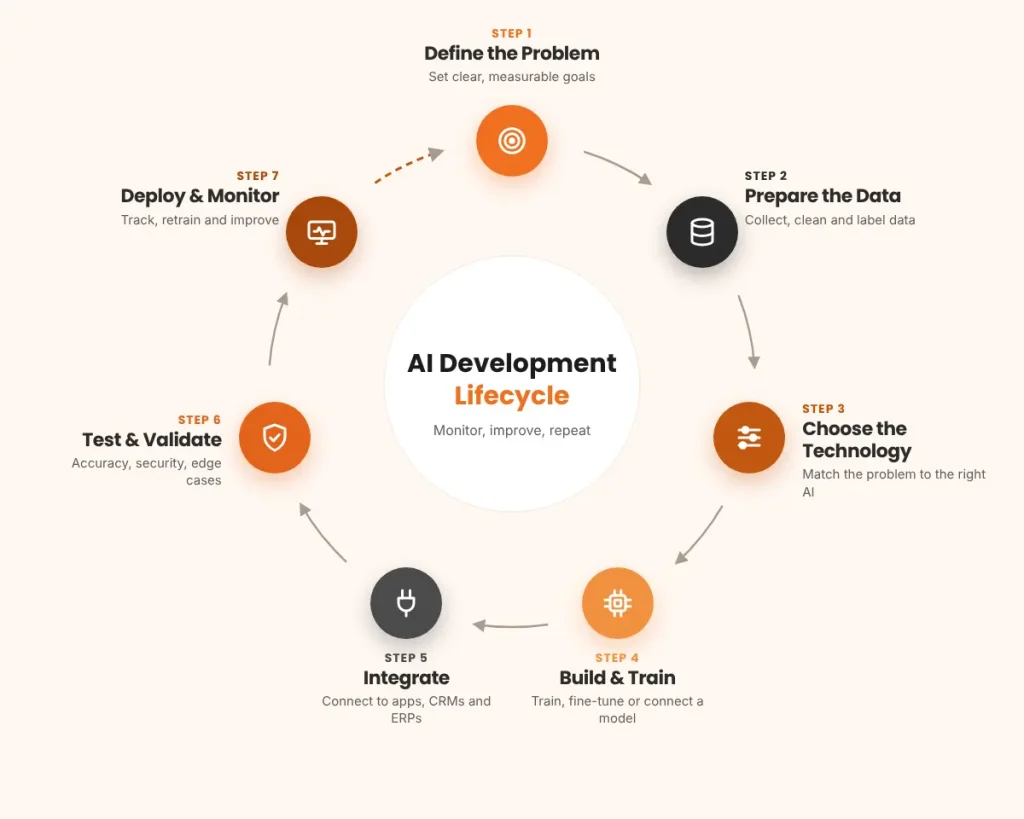 The AI development process involves several stages that help ensure the final solution meets business requirements and performs reliably.
Actual timelines should be established after reviewing the project scope, available data, security requirements, and integration dependencies.
Key Takeaways
- AI development involves designing, building, testing, and deploying software that performs tasks such as prediction, language understanding, pattern recognition, and content generation.
- Machine learning, deep learning, NLP, computer vision, generative AI, and AI agents are important AI technologies.
- The AI development process generally includes seven stages, from business requirement analysis to deployment and continuous monitoring.
- Businesses use AI for customer support, fraud detection, demand forecasting, document processing, and workflow automation.
- Custom AI development is useful when ready-made software cannot meet specific business requirements.
- Successful AI implementation depends on reliable data, suitable infrastructure, security, and human oversight.
- Choosing an experienced AI Development Company can help organizations build practical and scalable AI solutions.
What is AI Development?
AI development is the process of creating software applications and systems that can perform tasks normally associated with human intelligence. These tasks include recognizing patterns, understanding language, analyzing information, making predictions, and generating content. Traditional software generally follows predefined instructions written by developers. AI-powered software uses trained models to process information and produce outputs based on patterns learned during training. For example, a traditional customer support system may respond to specific keywords with predefined answers. An AI-powered assistant can interpret a customer's question, retrieve relevant information, and generate a contextual response.AI development typically involves:
- Identifying business problems and technical requirements.
- Collecting and preparing relevant data.
- Selecting appropriate AI models and technologies.
- Training, configuring, or integrating AI models.
- Developing applications and connecting business systems.
- Testing accuracy, reliability, and security.
- Deploying solutions and monitoring their performance.
How is AI Development Different From Traditional Software Development?
| Comparison | Traditional software | AI-powered software |
| Working approach | Follows predefined rules | Uses trained models and algorithms |
| Main requirements | Code and business logic | Data, models, code, and infrastructure |
| Predictions | Requires programmed logic | Can identify patterns and make predictions |
| New information | Usually requires rule updates | Can generalize from learned patterns |
| Maintenance | Code updates and bug fixes | Model evaluation, monitoring, and software updates |
Why is AI Development Important for Modern Businesses?
Businesses generate large amounts of information through websites, applications, customer interactions, transactions, and internal operations. Processing all this information manually can be time-consuming and expensive. AI helps organizations analyze information, automate repetitive activities, and support better business decisions. Here are some important benefits.1. Improved Operational Efficiency
AI can automate repetitive tasks such as document classification, invoice processing, email sorting, data entry, and customer query handling. This allows employees to focus on activities that require creativity, judgment, and strategic thinking.2. Better Business Decisions
Machine learning models can analyze historical and current data to identify trends, forecast demand, and support business planning. For example, a retail business can use predictive analytics to estimate future product demand and plan inventory accordingly.3. Enhanced Customer Experience
AI-powered chatbots, recommendation engines, and virtual assistants can provide faster responses and more personalized interactions. Businesses can use customer information and previous interactions to deliver more relevant experiences.4. Faster Data Analysis
AI can process large datasets and identify patterns that may be difficult to discover through manual analysis. This is particularly useful for organizations working with complex operational, financial, and customer data.5. Improved Business Scalability
AI applications can handle increasing workloads when supported by suitable infrastructure and system architecture. For example, an AI customer support assistant can handle multiple routine customer queries without requiring a human employee to respond to every interaction.What Technologies are Used in AI Development?
AI development combines different technologies depending on the business problem, available data, and expected outcomes.
The following six technologies are commonly used in modern AI applications.
1. Machine Learning (ML)
Machine learning is a branch of AI that enables computer systems to learn patterns from data and make predictions without requiring every instruction to be programmed manually. Models are trained using historical or collected information and evaluated against data they have not previously encountered.Common business applications:
- Sales and demand forecasting.
- Fraud detection.
- Customer segmentation.
- Product recommendations.
- Predictive maintenance.
- Customer behavior analysis.
2. Deep Learning
Deep learning is a specialized area of machine learning that uses multi-layered neural networks to identify complex patterns in information. It is particularly useful for analyzing unstructured data, including images, audio, video, and natural language.Common applications include:
- Image and facial recognition.
- Speech recognition.
- Medical image analysis.
- Advanced language processing.
- Visual quality inspection.
3. Natural Language Processing (NLP)
Natural Language Processing enables computers to understand, analyze, and generate human language. It helps applications process written or spoken communication and respond to users in a meaningful way.Common applications include:
- AI chatbots and virtual assistants.
- Customer feedback analysis.
- Document summarization.
- Language translation.
- Automated email processing.
- Text classification.
4. Generative AI
Generative AI refers to systems that create new content, such as text, images, audio, video, and code, based on patterns learned during training and instructions provided by users. Large Language Models (LLMs) power many text-based generative AI applications.Businesses can use generative AI to build:
- AI-powered content assistants.
- Business research applications.
- Intelligent document processing systems.
- Conversational applications.
- Internal knowledge assistants.
- Code generation tools.
5. Computer Vision
Computer vision enables machines to interpret and analyze visual information, including images and videos. It helps AI systems recognize objects, classify images, and identify visual patterns.Business applications include:
- Manufacturing quality inspection.
- Inventory monitoring.
- Document recognition.
- Object detection.
- Image classification.
- Security monitoring.
6. AI Agents
AI agents are systems designed to work toward specific goals by understanding information, planning actions, and using approved tools or applications within defined permissions. Unlike a basic chatbot that primarily answers questions, an AI agent may perform several connected steps to complete a task. For example, a customer support agent could retrieve an order status, check the return policy, prepare a response, and request human approval before sending an update.Common applications include:
- Customer support automation.
- IT service management.
- Business workflow automation.
- Enterprise knowledge retrieval.
- Research assistance.
- Operational task coordination.
Which AI Technology is Best for Different Business Problems?
| Business requirement | Suitable technology |
| Predict future sales | Machine learning |
| Analyze customer feedback | Natural Language Processing |
| Identify product defects | Computer vision |
| Generate reports and summaries | Generative AI |
| Automate multi-step tasks | AI agents |
| Detect unusual transactions | Machine learning and anomaly detection |
What is the AI Development Process? (Step by Step)
The AI development process involves several stages that help ensure the final solution meets business requirements and performs reliably.
Step 1: Identify Business Requirements
- The first step is understanding the problem the organization wants to solve.
- Development teams work with business stakeholders to identify objectives, technical requirements, expected outcomes, and project limitations.
- For example, a logistics company may want to reduce delivery delays by predicting potential disruptions.
- Clear objectives and measurable performance indicators should be established before development begins.
Step 2: Collect and Prepare Data
Data is the foundation of most AI applications. Developers identify relevant data sources and prepare information for model development. This stage may include:- Collecting information from business databases and applications.
- Removing duplicate and incorrect records.
- Handling missing values.
- Standardizing data formats.
- Labeling datasets when required.
- Reviewing data quality and permissions.
Step 3: Select the Right AI Technology
- Once the requirements and available data are understood, developers select the appropriate technology.
- Depending on the project, this could involve machine learning, NLP, computer vision, generative AI, or AI agents.
- The technology should be selected based on the business problem rather than current trends.
Step 4: Develop and Train the AI Model
- In this stage, developers build, configure, or integrate the selected model.
- Depending on the application, this may involve training a machine learning model, fine-tuning an existing model, integrating an AI API, or configuring an LLM-based application.
- The model is evaluated using relevant performance metrics to determine whether it meets the required standards.
Step 5: Develop the Application and Integrate Systems
- An AI model becomes useful when employees or customers can access its capabilities through an application or business workflow.
- Developers integrate AI functionality into websites, mobile applications, CRM platforms, ERP systems, databases, and internal business tools.
- This stage may involve APIs, backend development, user interfaces, cloud infrastructure, authentication, and third-party integrations.
Step 6: Test and Validate the Solution
Before deployment, the application must be tested under realistic conditions.Testing may include:
- Model accuracy and performance.
- Response quality and relevance.
- System reliability.
- Data security and access controls.
- Integration compatibility.
- Response time and scalability.
- Unexpected inputs and failure scenarios.
Step 7: Deploy, Monitor, and Improve
After successful validation, the AI application is deployed into the production environment. However, development does not end at deployment. Teams must monitor performance, identify issues, evaluate model changes, and improve the application as business requirements evolve. This may involve updating prompts, retraining models, improving data pipelines, or adding new capabilities.How Long Does AI Development Take?
AI development timelines depend on project complexity, data readiness, integrations, infrastructure, and testing requirements. A small proof of concept may take a few weeks, while a complete enterprise AI application with multiple integrations may require several months. The following table provides illustrative planning ranges rather than guaranteed delivery estimates.| Project type | Indicative timeline |
| Basic AI proof of concept | 2–4 weeks |
| AI chatbot application | 4–8 weeks |
| Machine learning application | 6–12 weeks |
| RAG-based knowledge assistant | 6–12 weeks |
| Complex enterprise AI platform | Several months |
What are the Real-World Applications of AI Development?
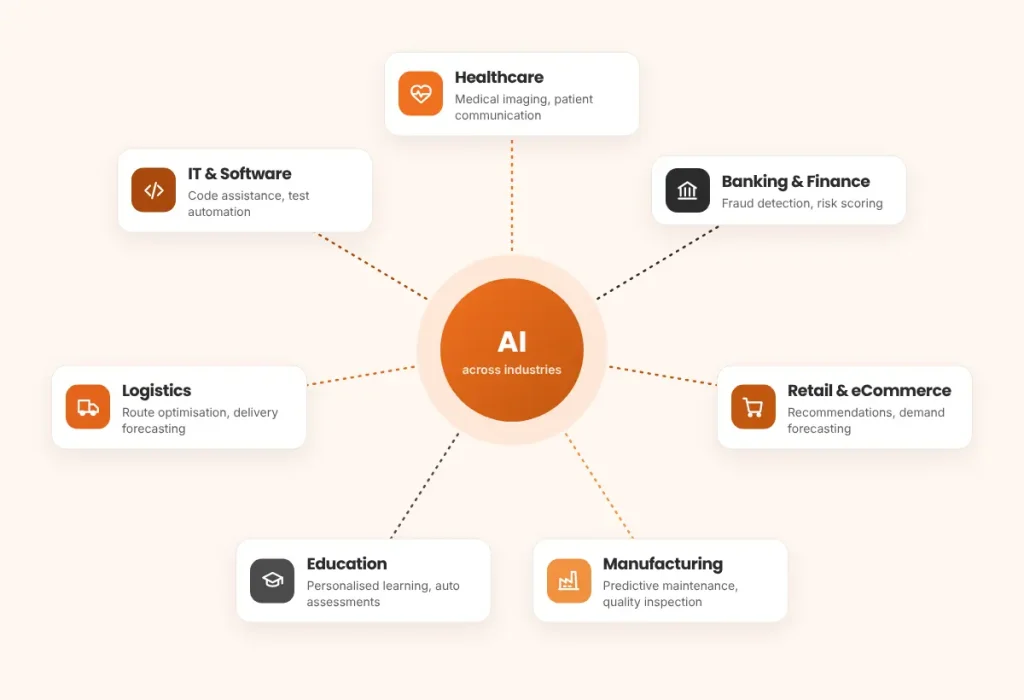
AI is being adopted across industries to improve business operations, analyze information, and develop intelligent digital experiences.
Here are some common applications.
- Healthcare: Medical image analysis, administrative automation, patient communication, and clinical decision support with professional oversight.
- Banking and finance: Fraud detection, transaction monitoring, risk assessment, document processing, and customer service.
- Retail and e-commerce: Product recommendations, demand forecasting, customer segmentation, inventory planning, and personalized shopping experiences.
- Manufacturing: Predictive maintenance, automated quality inspection, production monitoring, and supply chain planning.
- Education: Personalized learning, automated assessments, student assistance, and educational content recommendations.
- Logistics: Route optimization, delivery forecasting, warehouse management, and shipment tracking.
- IT and software development: Code assistance, automated testing, incident classification, log analysis, and IT helpdesk automation.
Custom AI Development vs. Ready-Made AI Solutions: Which is Better?
Businesses often need to decide whether to purchase an existing AI application or invest in custom development. Ready-made AI solutions are prebuilt products designed for common business requirements. Custom AI solutions are developed around specific business workflows, data, integrations, and technical requirements.| Comparison | Ready-made AI solutions | Custom AI solutions |
| Implementation | Usually faster | Depends on project scope |
| Customization | Limited to available features | Designed around business requirements |
| Integration | Depends on vendor support | Built for required systems |
| Initial investment | Often lower | Usually higher |
| Control | Depends on the provider | Greater architectural control |
| Maintenance | Often provider-managed | Requires an agreed support plan |
| Best suited for | Standard business needs | Specialized requirements |
When should businesses choose custom AI development?
Custom AI Development Services may be suitable when:- Existing applications cannot support specific business workflows.
- The organization needs integration with internal systems.
- Business data requires specialized processing.
- The application needs industry-specific functionality.
- Greater control over architecture and implementation is important.
How Much Do AI Development Services Cost?
The cost of AI development varies depending on the functionality, technical complexity, data requirements, integrations, infrastructure, and ongoing support. A simple AI-powered chatbot and an enterprise-grade AI platform require very different development efforts. Important factors affecting project costs include:- Project complexity: Applications involving multiple AI models, advanced workflows, and complex integrations generally require more development effort.
- Data requirements: Data collection, preparation, cleaning, labeling, and management can influence the overall budget.
- Model selection: Using an existing AI API, fine-tuning a model, or developing a specialized machine learning model involves different costs.
- Infrastructure: Cloud computing, storage, model hosting, and processing requirements contribute to operational expenses.
- Integration requirements: Connecting AI applications with existing CRM, ERP, databases, and enterprise platforms can increase project complexity.
- Maintenance: Monitoring, security updates, model evaluation, and application improvements should be included in long-term planning.
Why Hire an AI Development Company?
Building an AI application requires a combination of software engineering, machine learning, data engineering, system architecture, testing, and deployment expertise. An experienced AI Development Company can help businesses coordinate these technical requirements and select suitable development approaches. Some important benefits include:- Technical expertise: Access to AI engineers, software developers, data engineers, and solution architects.
- Technology selection: Guidance on choosing suitable AI models, frameworks, APIs, and infrastructure.
- Efficient implementation: A structured development process that helps avoid common technical issues.
- System integration: Connecting AI applications with existing business software and workflows.
- Scalable development: Designing applications that can accommodate changing business requirements.
- Post-launch support: Assistance with monitoring, maintenance, troubleshooting, and improvements.
How to Choose the Right AI Development Agency
Before selecting an AI development agency or planning to hire AI developers, evaluate these factors:- Technical experience in machine learning, NLP, generative AI, computer vision, and AI agents.
- Relevant project examples and industry experience.
- Data engineering and application integration capabilities.
- Security practices and data protection procedures.
- Scalable architecture and infrastructure knowledge.
- Transparent communication and project management.
- Post-deployment monitoring and maintenance support.
Also Read: How to Choose the Best AI Development Company in the USA
What Are the Biggest Challenges in AI Development?
Although AI offers several business opportunities, organizations must consider potential challenges before implementing it.- Data quality: Incomplete, outdated, or inconsistent information can affect model performance.
- Data privacy and security: Businesses must protect sensitive information through appropriate access controls, encryption, and data management practices.
- Integration complexity: Connecting AI applications with legacy software and existing business systems can require careful technical planning.
- Model accuracy: AI models may generate incorrect predictions or responses. Important outputs should be evaluated and reviewed by qualified people.
- Infrastructure and costs: Computing resources, model hosting, integrations, and ongoing maintenance contribute to the total cost of ownership.
- AI governance: Organizations should establish clear policies covering system permissions, data usage, human oversight, and accountability.
What is the Future of AI Development?
AI development is moving beyond basic automation and individual models toward connected applications that can work with different data sources and support complex business workflows. Several developments are shaping this direction.- Agentic AI: AI agents are becoming more capable of coordinating multi-step tasks and interacting with approved tools under defined permissions.
- Multimodal AI: Modern AI systems can work with different information types, including text, images, audio, and video.
- Retrieval-Augmented Generation: RAG helps businesses connect generative AI applications with internal documents and knowledge sources.
- Specialized AI models: Smaller models designed for particular tasks can offer useful alternatives when cost, speed, privacy, or infrastructure requirements matter.
- Responsible AI: Security, data privacy, model reliability, explainability, and human oversight are becoming important considerations in enterprise AI projects.
How Spiral Mantra Helps Businesses with AI Development
Successful AI implementation requires more than selecting an AI model. Businesses need suitable data, reliable software architecture, system integration, testing, and ongoing technical support. Spiral Mantra is a digital transformation and IT consulting company offering technology solutions across AI/ML, data engineering, cloud and DevOps, application development, and product engineering. Through its Artificial Intelligence Development Services, Spiral Mantra helps businesses explore and implement AI-powered solutions based on their technical and operational requirements. Its AI capabilities include:- AI consulting and development.
- Machine learning model development and integration.
- Generative AI application development.
- AI chatbot and voice agent development.
- AI agent development and workflow automation.
- RAG-based knowledge assistants.
- Predictive analytics.
- AI application integration and customization.