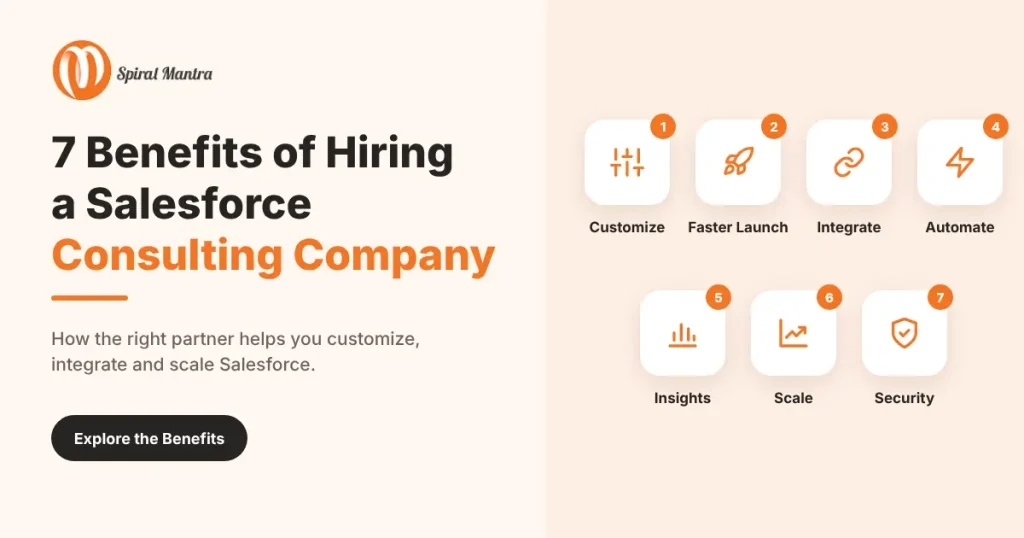
7 Benefits of Hiring a Salesforce Consulting Company for Your Business
Buying Salesforce licenses is the easy part. Making the platform fit your sales process, connect with your existing systems, and work effectively for your team is where many businesses face challenges. This is where a Salesforce consulting company can help.
Without a clear implementation strategy, businesses may experience disconnected systems, duplicate data, low user adoption, and unexpected costs. With the right Salesforce consulting services, organizations can build a CRM environment that supports daily operations and long-term business growth.
Salesforce provides tools for sales, marketing, customer service, automation, and analytics. However, getting the most value from these capabilities requires the right configuration, integration, and ongoing management.
For CTOs, CEOs, business owners, product leaders, and IT managers, hiring Salesforce consultants is not just a technology decision. It is an opportunity to improve productivity, strengthen customer relationships, and make better business decisions.
In this guide, we explore seven benefits of hiring a Salesforce consulting company, when to consider professional consulting, how to choose the right partner, and whether you should hire Salesforce developers or work with a consulting team.
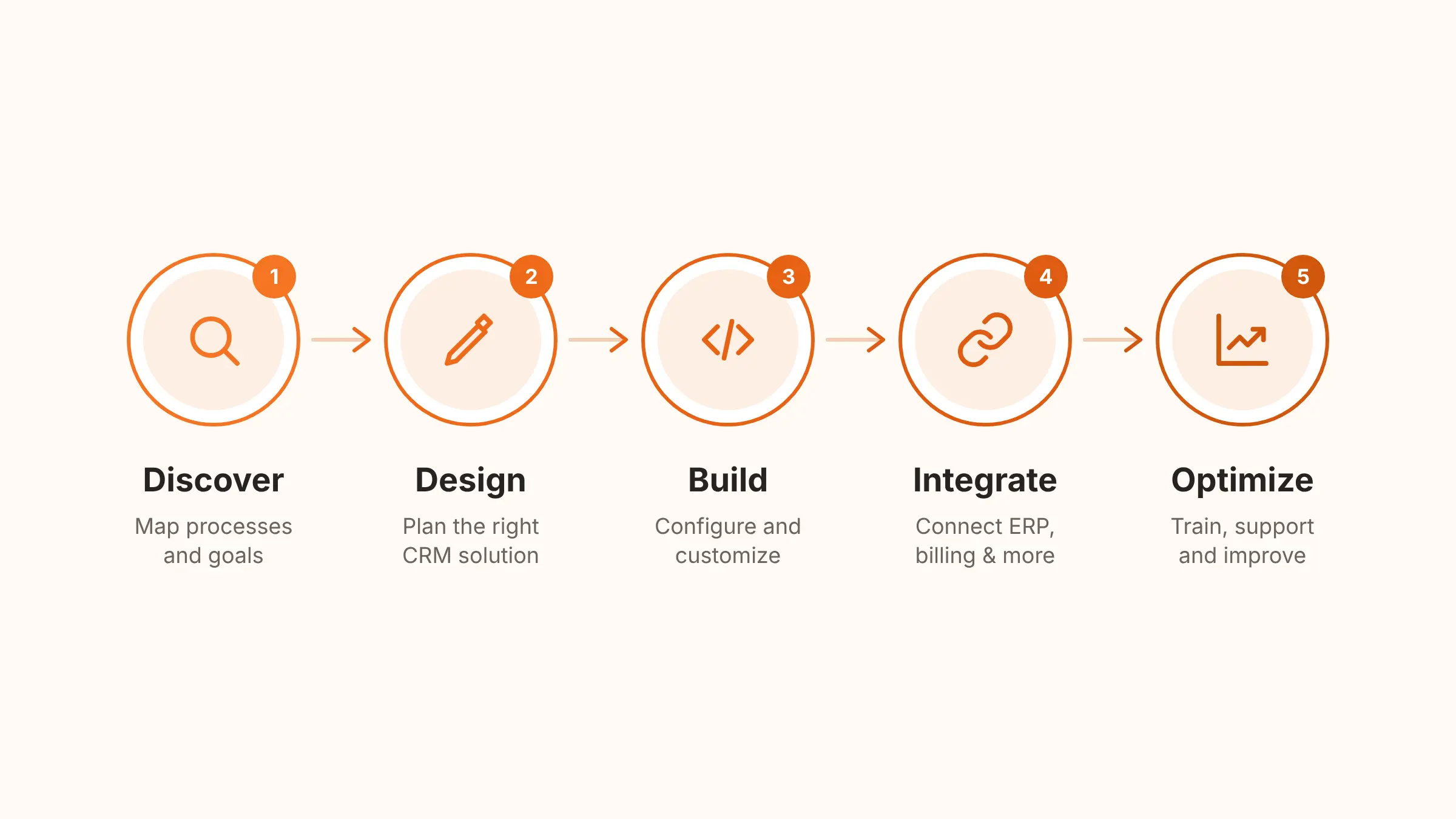
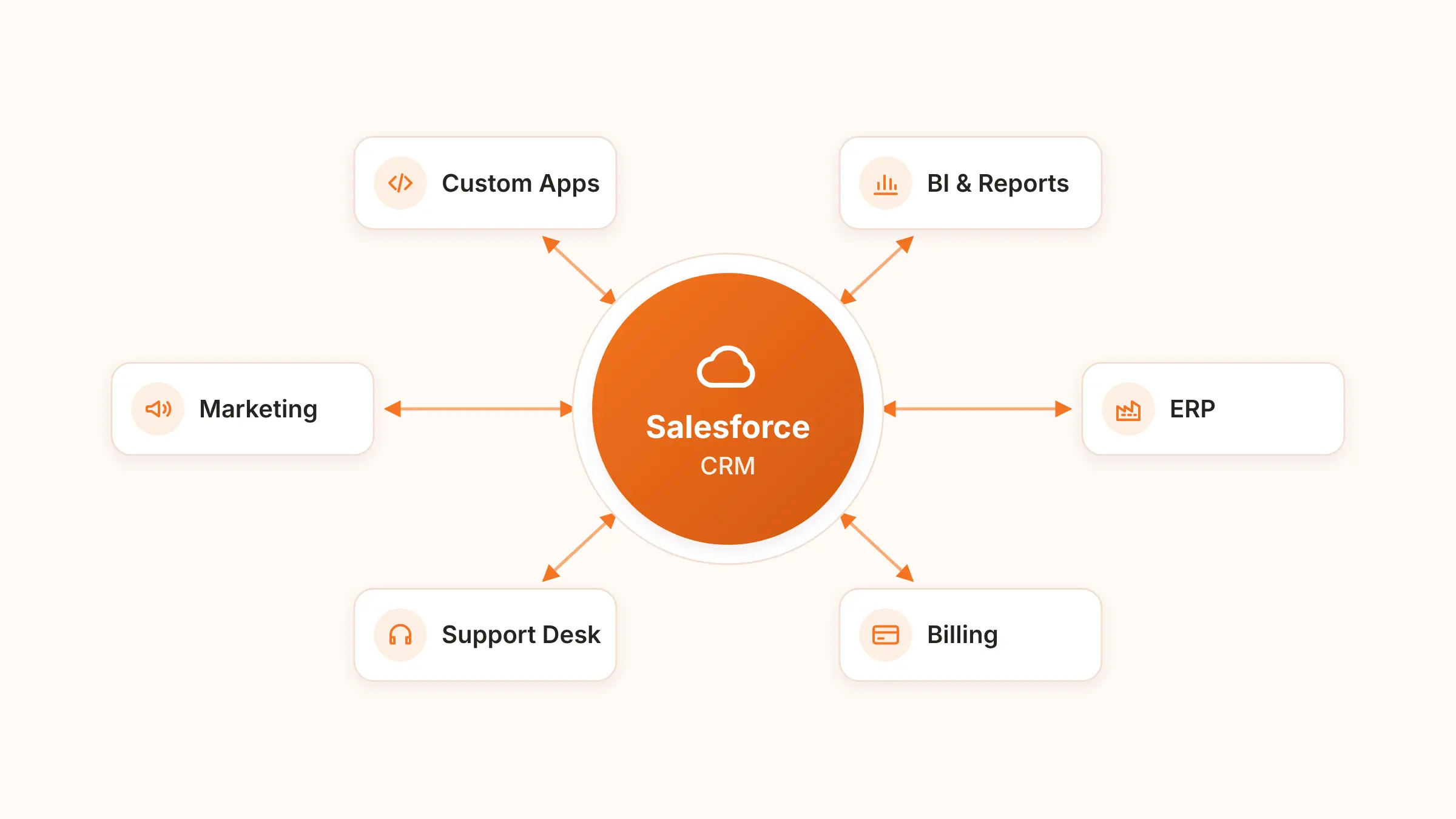 For example, when a sales representative closes a deal, an integration may transfer the required order details to an ERP system. This can reduce manual data entry and help the operations team begin order processing sooner.
However, successful integration requires more than connecting two applications.
The technical team must consider authentication, field mapping, data ownership, synchronization frequency, error handling, and security. It must also establish which application acts as the authoritative source for each type of information.
For businesses with complex technology environments, these decisions are particularly important.
 Before hiring a consulting partner, identify the specific problem you want to solve and define the results you expect.
For example, your objective might be to reduce manual lead assignment, improve customer data quality, or connect Salesforce with an existing ERP system.
Clear objectives make it easier to define project scope and evaluate whether the solution delivers value.
Key Takeaways
- Customized CRM: Salesforce consultants configure the platform around your business processes and reporting requirements.
- Better implementation planning: Experienced consultants help identify risks, manage dependencies, and reduce avoidable rework.
- Connected applications: Salesforce Integration services help exchange information between CRM, ERP, marketing, and other business systems.
- Improved productivity: Workflow automation reduces repetitive tasks and supports consistent business processes.
- Better decisions: Reliable reports and dashboards help leaders monitor performance and identify business trends.
- Scalability: A well-designed Salesforce environment can adapt as your business grows.
- Security and governance: Appropriate access controls and development practices help protect business information.
- Choosing the right partner: Consider project experience, technical capabilities, communication, and ongoing support before making a decision.
What Does a Salesforce Consulting Company Do?
A Salesforce consulting company helps businesses plan, implement, customize, integrate, and optimize Salesforce according to their business requirements. Instead of simply configuring software, consultants examine existing processes, identify operational challenges, and recommend a suitable CRM solution. Typical Salesforce consulting services include:- Salesforce strategy and business process analysis.
- CRM implementation and configuration.
- Custom objects, fields, and workflow development.
- Sales and customer service automation.
- Salesforce Integration services.
- Data migration and data quality management.
- Reports, dashboards, and analytics.
- Security configuration and access management.
- User training and ongoing CRM optimization.
7 Benefits of Hiring a Salesforce Consulting Company
1. Customize Salesforce to Match Your Business Needs
Every business has different processes, customers, and operational requirements. A manufacturing company may need distributor management and territory-based sales processes, while a software company may focus on lead qualification, subscription renewals, and customer success. A default CRM configuration may not adequately support both businesses. A Salesforce consulting company helps configure the platform around your actual business requirements. Consultants examine your customer journey, existing workflows, reporting needs, and operational challenges before recommending a solution. Customization may include:- Creating custom objects and fields.
- Configuring sales stages around your sales cycle.
- Setting up user roles and permissions.
- Automating approvals and repetitive tasks.
- Creating dashboards for different departments.
- Developing custom functionality when standard features are insufficient.
Business benefit:
A CRM configured around your operations can improve usability, support consistent processes, and make it easier for employees to manage customer information.2. Reduce Implementation Risks and Avoid Costly Mistakes
Salesforce implementation involves several stages, including requirements gathering, solution design, configuration, data migration, testing, and user training. If businesses overlook important requirements or begin development without a clear plan, they may encounter delays, unexpected expenses, and technical problems. Salesforce consulting services can help bring structure to the implementation process. Consultants can help your team:- Define project objectives and requirements.
- Prioritize essential features for the initial launch.
- Identify technical dependencies.
- Prepare data before migration.
- Plan testing and deployment.
- Establish user training and adoption processes.
Business benefit:
Structured implementation planning helps businesses manage risks, reduce rework, and make project timelines and budgets more predictable.3. Connect Business Applications With Salesforce Integration Services
Many businesses use separate applications for accounting, marketing, inventory, billing, customer support, and enterprise resource planning. When these systems do not communicate effectively, employees may hae to enter the same information into multiple applications. This creates unnecessary work and increases the risk of inconsistent records. Salesforce Integration services connect Salesforce with relevant business applications so information can move between systems according to defined business rules. Common integration requirements include:- Connecting Salesforce with an ERP system to exchange order and customer information.
- Synchronizing marketing campaign information with sales records.
- Connecting customer support applications with CRM customer profiles.
- Sharing billing information with appropriate business systems.
- Integrating internal applications through APIs.
- Connecting Salesforce data with business intelligence platforms.
For example, when a sales representative closes a deal, an integration may transfer the required order details to an ERP system. This can reduce manual data entry and help the operations team begin order processing sooner.
However, successful integration requires more than connecting two applications.
The technical team must consider authentication, field mapping, data ownership, synchronization frequency, error handling, and security. It must also establish which application acts as the authoritative source for each type of information.
For businesses with complex technology environments, these decisions are particularly important.
Business benefit:
Well-designed integrations improve information consistency, reduce repetitive work, and help departments coordinate their activities more effectively.4. Improve Productivity Through Workflow Automation
Employees often spend valuable time updating records, assigning leads, sending reminders, and performing other repetitive tasks. These activities may appear small individually, but they can consume significant time across a team. Manual processes can also lead to missed follow-ups and inconsistent execution. Salesforce consultants help identify suitable automation opportunities and configure workflows around business requirements. Examples include:- Assigning leads according to territory or ownership rules.
- Creating follow-up tasks when opportunities reach specific stages.
- Sending notifications when approvals are required.
- Routing customer service cases to the appropriate team.
- Triggering reminders for upcoming renewals.
- Updating records when predefined conditions are met.
Business benefit:
Effective automation reduces repetitive work, improves process consistency, and allows employees to focus on customer relationships and other higher-value activities.5. Make Better Decisions With Reports and Dashboards
Business leaders need reliable information to evaluate performance, identify problems, and plan their next steps. However, when information is scattered across spreadsheets and disconnected applications, getting a clear picture of business performance becomes difficult. Salesforce reports and dashboards can help bring relevant CRM information together in a more accessible format. Depending on your business requirements, useful metrics may include:- Sales pipeline value.
- Lead conversion rates.
- Opportunity win rates.
- Sales cycle duration.
- Revenue by region or product.
- Customer service response times.
- Case resolution trends.
- Customer retention and renewal indicators.
Business benefit:
Reliable reporting gives decision-makers better visibility into operations and helps them investigate trends using consistent information.6. Build a Scalable CRM Environment for Future Growth
A Salesforce configuration that works for a small team may become difficult to manage as a business expands. Growth may introduce new departments, additional products, different sales processes, more users, and new technology requirements. A Salesforce consulting company can help design an environment that supports current needs while allowing for future changes. Scalability planning may include:- Designing a consistent data model.
- Establishing user roles and access permissions.
- Creating maintainable automation.
- Planning integration architecture.
- Documenting technical configurations.
- Establishing testing and release management practices.
- Evaluating when custom development is necessary.
Business benefit:
Scalable CRM architecture helps businesses adapt to changing requirements while keeping their technology environment manageable.7. Strengthen Data Security and Governance
Salesforce environments may contain customer information, sales records, contractual details, and other sensitive business data. Protecting this information requires appropriate security configuration, access management, and governance practices. Salesforce provides security capabilities, but businesses must configure them according to their information, operational requirements, and applicable obligations. Salesforce consultants can help businesses review and establish practices such as:- Applying the principle of least privilege.
- Configuring object-, field-, and record-level access.
- Establishing appropriate authentication controls.
- Managing development, testing, and production environments.
- Reviewing integration permissions and credentials.
- Documenting configuration changes.
- Establishing data quality and retention procedures.
Business benefit:
Appropriate security and governance practices help protect sensitive information, control access, and support more responsible CRM management.When Should You Hire Salesforce Consultants?
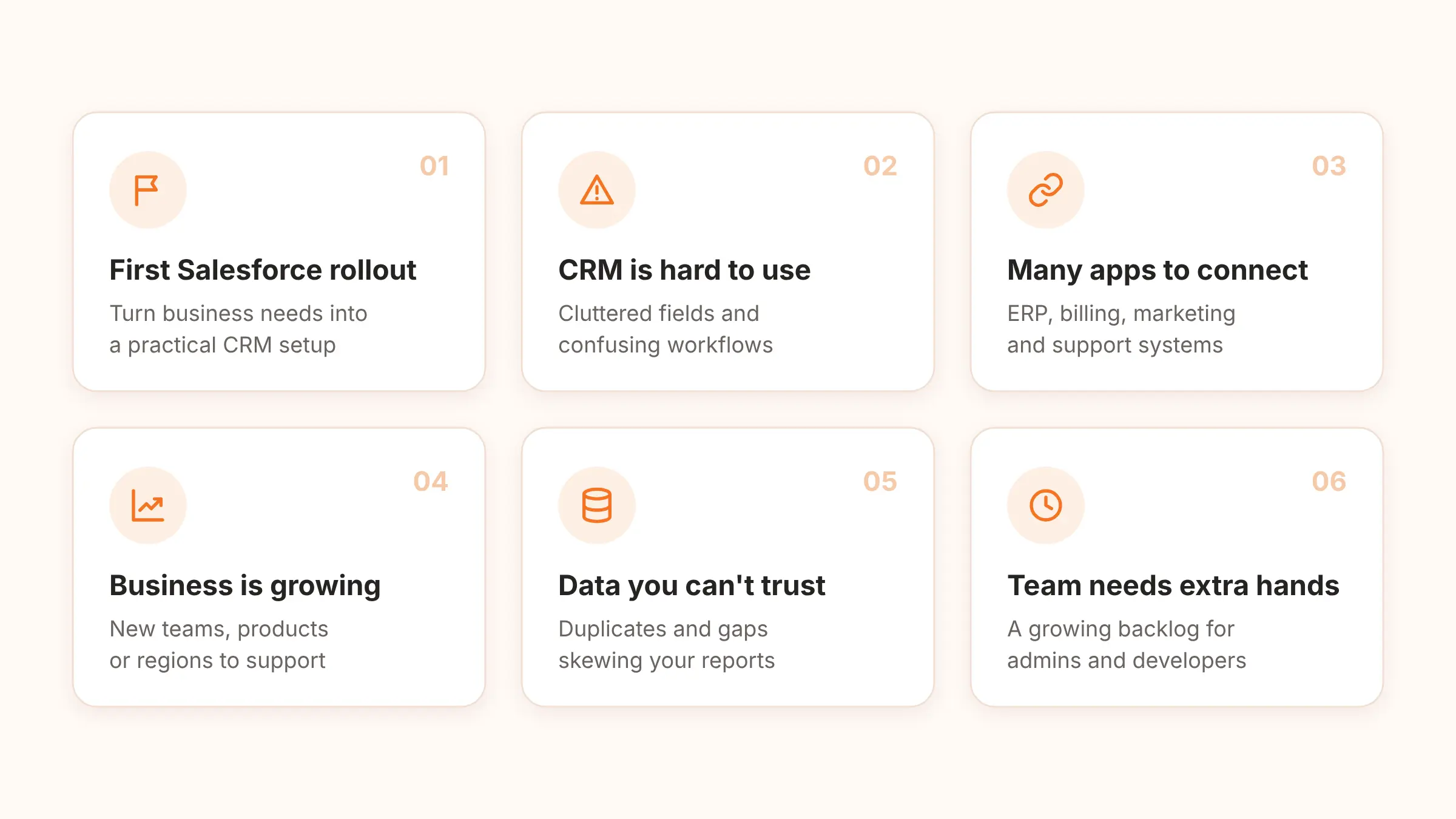
Hiring Salesforce consultants can be particularly useful when your business faces challenges that require specialized CRM knowledge or technical expertise. Consider professional consulting if:- You are implementing Salesforce for the first time.
- Your existing CRM is difficult to use or maintain.
- You need to integrate Salesforce with multiple applications.
- Your business is expanding into new markets or departments.
- Duplicate or incomplete data is affecting reporting.
- Your workflows require complex automation.
- Your internal Salesforce team has a growing project backlog.
- You need support with CRM architecture, security, or migration.
Before hiring a consulting partner, identify the specific problem you want to solve and define the results you expect.
For example, your objective might be to reduce manual lead assignment, improve customer data quality, or connect Salesforce with an existing ERP system.
Clear objectives make it easier to define project scope and evaluate whether the solution delivers value.
Salesforce Consulting Company vs. In-House Salesforce Developer
Businesses often need to decide whether to hire Salesforce developers directly or work with a consulting company. The right choice depends on your project scope, budget, timeline, and long-term support requirements.| Factor | Salesforce Consulting Company | In-House Salesforce Developer |
| Expertise | May provide access to consultants, developers, and other specialists | Depends on the individual's skills and experience |
| Project planning | Can support requirements, solution design, and implementation planning | May require additional business analysis and project management resources |
| Integration work | May provide experience across multiple applications and integration approaches | Depends on individual expertise and available resources |
| Business knowledge | Requires onboarding and collaboration with internal teams | Builds deeper organizational knowledge over time |
| Flexibility | Can provide project-based or ongoing support, depending on the agreement | Provides dedicated internal capacity |
| Best suited for | Implementations, migrations, complex integrations, and specialist projects | Ongoing development, administration, and internal enhancements |
Should You Hire Salesforce Developers or a Consulting Company?
Hire Salesforce developers when you primarily need coding expertise or a dedicated resource for ongoing development. Choose a Salesforce consulting company when your project also requires business analysis, architecture, implementation planning, integration, testing, and deployment support. Some businesses benefit from combining both approaches. An external consulting team can support a complex implementation, while an internal team manages daily operations and future improvements. Before you hire Salesforce developers, evaluate whether your requirement involves only custom coding or also needs broader technical and business expertise.How to Choose the Right Salesforce Consulting Company
Selecting the right partner is important for achieving your CRM objectives. Use the following checklist to evaluate potential Salesforce consulting companies.1. Relevant project experience
Ask about previous projects involving requirements similar to yours. Request case studies or references where available, and look for evidence of how the team addressed comparable challenges.2. Technical capabilities
Evaluate the team's experience with Salesforce configuration, development, data migration, automation, and integration.3. Business understanding
A suitable partner should understand your business objectives and existing workflows before recommending technology.4. Integration expertise
If you use several business applications, ask how the company handles APIs, data mapping, authentication, synchronization, and integration errors.5. Security and development practices
Discuss access controls, testing, documentation, change management, and deployment procedures.6. Communication and project management
Look for clear deliverables, defined responsibilities, realistic timelines, and regular progress updates.7. Training and ongoing support
Check whether the engagement includes documentation, knowledge transfer, user training, and post-implementation assistance.8. Transparent scope and pricing
Compare proposals based on deliverables, assumptions, dependencies, and support arrangements rather than price alone. A clear evaluation process helps you select a partner whose capabilities match your business requirements.How Much Do Salesforce Consulting Services Cost?
The cost of Salesforce consulting services depends on project scope, technical complexity, integrations, data migration, customization, and ongoing support requirements. A small configuration project will generally require a different level of effort from an enterprise implementation involving multiple applications and complex business processes. Common pricing models include hourly consulting, fixed project fees, and monthly support arrangements. To estimate costs more accurately:- Document your business and technical requirements.
- Identify the applications that need to be integrated.
- Prioritize essential features.
- Assess data migration and cleanup requirements.
- Define testing, training, and support expectations.
- Request a detailed proposal with clear deliverables.