What is Data Analytics Consulting? A Complete Guide for Businesses
Key Takeaways
- Data Analytics Consulting helps businesses transform raw data into insights that support better decisions.
- Common services include data integration, business intelligence, dashboards, predictive analytics, and data governance.
- Data Engineering Services establish the reliable data infrastructure needed for accurate reporting and analysis.
- Businesses can use analytics to improve forecasting, customer experiences, operational efficiency, and performance measurement.
- Consulting costs depend on project scope, data quality, technology requirements, and ongoing support.
- The right consulting partner should understand your business objectives, technical environment, security requirements, and expected outcomes.
What Is Data Analytics Consulting?
Data analytics consulting is a professional service that helps organizations collect, organize, analyze, and interpret data to answer important business questions. Consultants combine analytical methods, business understanding, and technology to turn complex information into practical recommendations. The objective is not simply to generate reports. It is to help businesses understand what their data reveals and determine what actions they should take. For example, an e-commerce company might experience a high volume of website traffic but relatively few completed purchases. A data analytics consultant could examine website behavior, product pricing, checkout activity, marketing campaigns, and customer feedback to identify possible reasons for the low conversion rate. The findings might reveal that customers frequently abandon their carts after seeing delivery charges or encountering a complicated checkout process. The business could then test improvements and measure whether conversion rates increase. Data analytics consulting can support many business decisions, from reducing operating costs and improving inventory planning to understanding customer behavior and evaluating marketing performance.What Does a Data Analytics Consultant Do?
A data analytics consultant starts by understanding the business problem rather than immediately recommending a particular tool. The consultant then identifies the relevant data, evaluates its quality, performs the necessary analysis, and communicates the findings. Typical responsibilities include assessing existing data systems, integrating information from multiple sources, developing dashboards, analyzing trends, building forecasts, and recommending improvements. Consultants may work with data analysts, data engineers, business intelligence specialists, and data scientists, depending on the complexity of the project. For instance, a subscription-based software company experiencing customer churn might combine product usage records, billing information, and support tickets to understand why customers cancel. The resulting insights could help the business improve onboarding, address product issues, and develop more effective retention strategies. The most useful outcome is a clear connection between data findings and business action.Why Is Data Analytics Consulting Important for Businesses?
Businesses generate information through sales transactions, customer interactions, financial systems, marketing campaigns, and operational processes. However, having large amounts of data does not automatically lead to better decisions. Information may be incomplete, stored in disconnected systems, or presented in reports that different departments interpret differently. Data analytics consulting helps organizations address these challenges and make their information more useful.1. Improve Business Decision-Making
Reliable analytics helps decision-makers understand performance before changing business strategies. Instead of relying entirely on assumptions, managers can compare results, identify trends, and evaluate possible actions. For example, a business considering expansion into a new market could analyze customer demand, regional sales, operating costs, and purchasing patterns before committing resources.2. Increase Operational Efficiency
Analytics can reveal delays, duplicated work, unnecessary expenses, and recurring process problems. A logistics company, for example, could analyze delivery records to identify routes associated with frequent delays or higher fuel consumption. Managers could use these findings to review route planning and improve resource allocation.3. Understand Customer Behavior
Customer data can help businesses identify purchasing patterns, service issues, product preferences, and reasons for customer churn. These insights can inform marketing campaigns, product improvements, customer support, and retention strategies.4. Improve Forecasting and Planning
Historical data can help organizations estimate future demand, sales, inventory requirements, and resource needs. Forecasts remain estimates rather than guarantees, but they can help businesses prepare for seasonal changes and reduce avoidable planning errors.5. Measure Business Performance
Dashboards and automated reports make it easier to monitor key performance indicators (KPIs), including revenue growth, conversion rates, customer retention, operating costs, and delivery performance. The value comes from using these measurements to guide decisions, not simply displaying them on a screen.What Services Are Included in Data Analytics Consulting?
The right combination of Data Analytics Solutions depends on a company's business objectives, existing systems, data quality, and technical capabilities. Some organizations need better reporting, while others require integrated data platforms and advanced analytical models. The following services are commonly included in data analytics consulting engagements.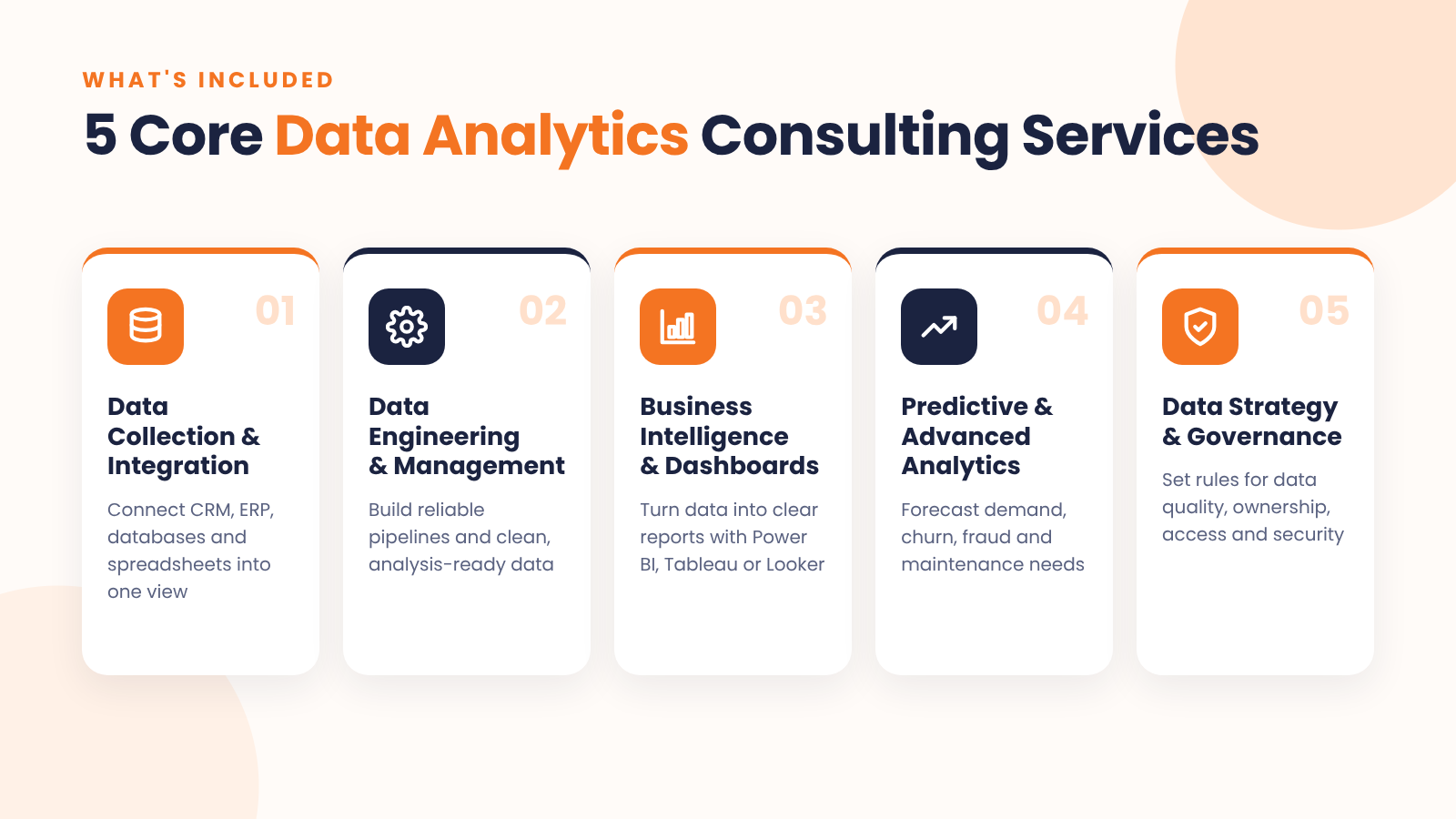
1. Data Collection and Integration
Businesses often store information across customer relationship management (CRM) systems, enterprise resource planning (ERP) software, databases, spreadsheets, and marketing platforms. Data integration connects these sources so that related information can be analyzed together. This helps reduce fragmented reporting and gives teams a more consistent view of business performance. For example, a retailer could combine sales transactions, inventory records, and customer purchasing history to understand which products sell well, which items frequently run out of stock, and where demand is changing.2. Data Engineering and Data Management
Reliable analytics begins with reliable data. Missing records, duplicate entries, inconsistent formats, and outdated information can lead to misleading reports. Data Engineering Services address the technical foundation by building and maintaining data pipelines, integrating systems, transforming information, and preparing data for analysis. Businesses may require data engineering consulting services to modernize legacy systems, automate data processing, establish data warehouses, or prepare information for business intelligence and AI applications. Working with experienced data engineering service providers can help organizations create a more dependable foundation for analytics.3. Business Intelligence and Data Visualization
Business intelligence (BI) converts organized data into understandable reports, dashboards, and visualizations. Consultants may use tools such as Microsoft Power BI, Tableau, or Looker to present relevant information. A sales dashboard might display revenue by region, product performance, monthly trends, and progress toward targets. Managers can use these views to identify changes and investigate problems without manually combining multiple spreadsheets. Effective dashboards focus on business questions and relevant KPIs rather than presenting every available metric.4. Predictive and Advanced Analytics
Predictive analytics uses historical data, statistical techniques, and, where appropriate, machine learning to estimate future outcomes. Common applications include demand forecasting, customer churn prediction, fraud detection, inventory planning, and predictive maintenance. For example, a manufacturer could analyze equipment maintenance records and sensor readings to identify patterns associated with potential failures. This information could help the company plan inspections and reduce unexpected interruptions. Predictive models should be tested and monitored because their performance can change as business conditions, customer behavior, and data patterns evolve.5. Data Strategy and Governance
Data strategy defines how an organization will use data to support its objectives. Data governance establishes rules for data ownership, quality, access, security, and responsible usage. Consultants may help businesses standardize KPI definitions, document data sources, establish ownership responsibilities, and implement appropriate access controls. These practices are particularly important when organizations work with sensitive customer information, financial records, or regulated data.How Does Data Analytics Consulting Work?
A structured consulting process helps ensure that analytics projects solve genuine business problems and deliver measurable value.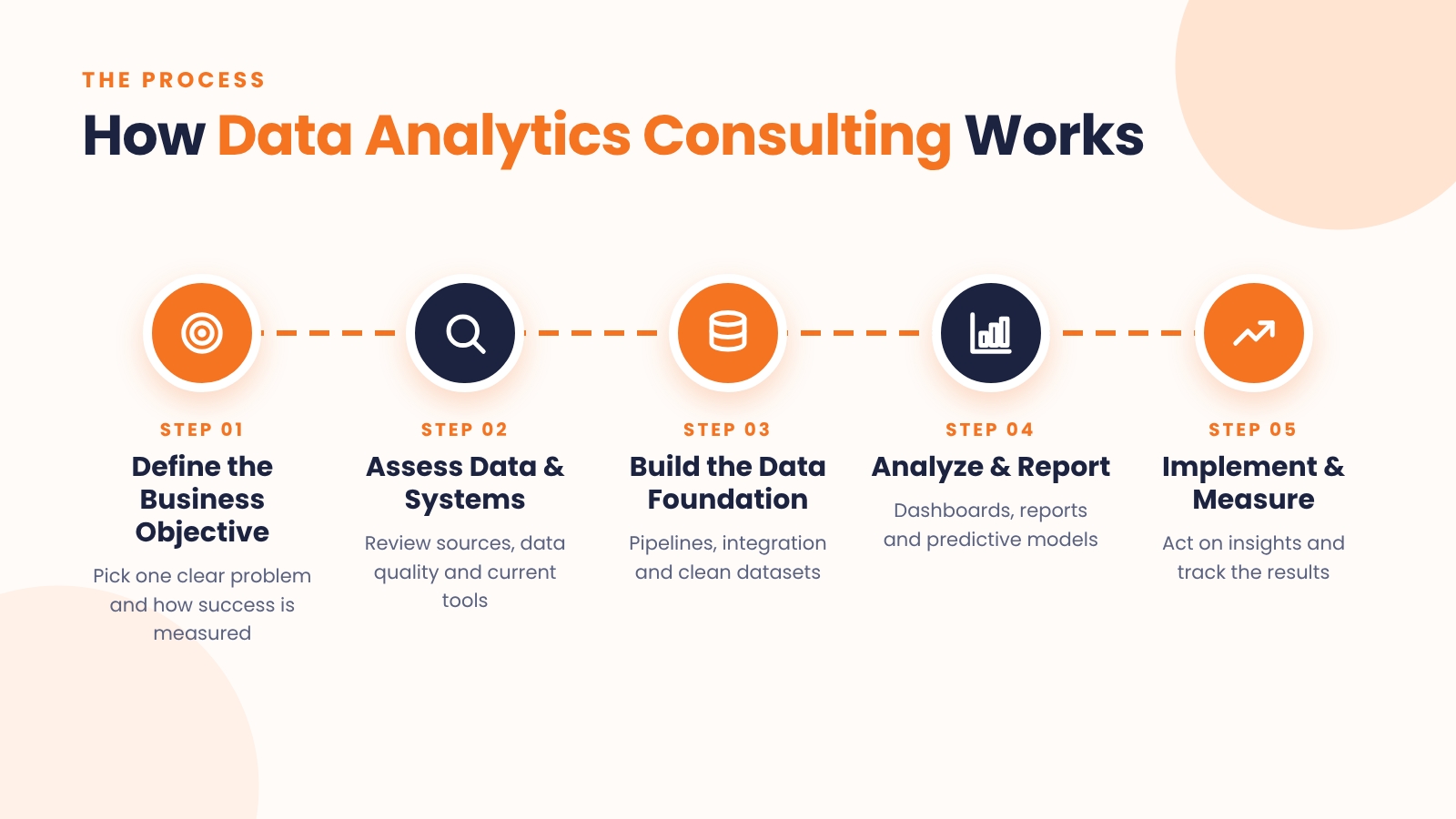
Step 1: Define the Business Objective
The first step is identifying a specific challenge. The business might want to reduce customer churn, improve sales forecasting, automate reporting, or understand marketing performance. The objective should be clear enough to guide the project and establish how success will be measured.Step 2: Assess Existing Data and Systems
Consultants review the organization's data sources, databases, reporting processes, and existing technology. They evaluate data quality, identify integration challenges, and determine whether the current infrastructure can support the project. This assessment helps avoid unnecessary technology investments.Step 3: Build the Data Foundation
When required, data engineers develop pipelines, integrate systems, clean information, and prepare datasets for analysis. A smaller organization may need a straightforward reporting database, while a larger business may require a cloud-based data warehouse or lakehouse. The appropriate architecture depends on data volume, security requirements, existing platforms, and future needs.Step 4: Analyze Data and Develop Reports
The team selects suitable analytical methods and develops reports, dashboards, or predictive models. Findings should be checked for accuracy, interpreted in business context, and presented in language that decision-makers can understand.Step 5: Implement Recommendations and Measure Results
The final step is applying insights to business operations and evaluating the outcomes. For example, if a reporting project aims to reduce the time required to prepare monthly financial reports, the company can compare preparation time before and after implementation. Regular monitoring helps ensure that the solution continues to provide reliable information as business requirements change.Data Analytics Consulting vs. Data Engineering Services
Data analytics consulting and data engineering are closely connected, but they address different parts of the data lifecycle.| Comparison | Data Analytics Consulting | Data Engineering Services |
| Primary purpose | Turn data into actionable insights | Build reliable data infrastructure |
| Typical activities | Analysis, dashboards, reporting, forecasting | Data integration, pipelines, transformation, storage |
| Deliverables | Reports, visualizations, analytical findings | Data models, pipelines, warehouses, platforms |
| Main business benefit | Better-informed decisions | Reliable, accessible, analysis-ready data |
| Common technologies | SQL, Python, Power BI, Tableau | SQL, Python, cloud data platforms, orchestration tools |
Which Industries Benefit From Data Analytics Consulting?
Data analytics consulting can support organizations across industries because businesses in almost every sector need to understand performance, manage resources, and make informed decisions.| Industry | Common analytics applications |
| Retail and e-commerce | Demand forecasting, customer segmentation, sales trends, return analysis |
| Banking and financial services | Risk assessment, transaction monitoring, fraud detection, reporting |
| Healthcare | Appointment patterns, resource utilization, operational planning |
| Manufacturing | Quality analysis, equipment monitoring, production planning |
| Technology and SaaS | Customer churn, product adoption, subscription performance |
| Logistics and transportation | Delivery times, route efficiency, warehouse performance |
How Much Does Data Analytics Consulting Cost?
The cost of data analytics consulting varies according to project complexity, data quality, the number of systems involved, technology requirements, and the expertise needed. A project involving a single dashboard and a small number of clean data sources will generally require less work than an enterprise-wide analytics platform involving multiple integrations, complex data transformations, and predictive modeling. Consulting engagements commonly use three pricing approaches:| Pricing model | How it works | Suitable for |
| Fixed-price project | An agreed fee for a clearly defined scope | Well-defined dashboards, integrations, or reporting projects |
| Time and materials | Charges based on time spent and resources used | Projects where requirements may evolve |
| Monthly retainer | Recurring fee for ongoing support and improvements | Continuous analytics, maintenance, and reporting needs |
How to Choose the Right Data Analytics Consulting Partner
Choosing the right Data Engineering Company requires more than comparing technology lists. A consulting provider should understand your business goals and explain how its proposed approach will address them.
Consider these factors before making a decision.
Business understanding: The provider should ask about your challenges, existing processes, and expected outcomes before recommending tools.
Technical expertise: Look for relevant experience with data integration, databases, business intelligence, analytics, cloud platforms, and data governance.
Data quality and security: Ask how the team validates information, controls access, protects sensitive data, and addresses applicable compliance requirements.
Project experience: Review relevant case studies and ask what problem was solved, what work was completed, and how results were measured. Only rely on outcomes that can be substantiated.
Communication and documentation: Consultants should explain technical findings in plain language and provide documentation that helps your team understand and maintain the solution.
Clear scope and ownership: Confirm deliverables, timelines, support arrangements, and ownership of dashboards, code, data models, and documentation.