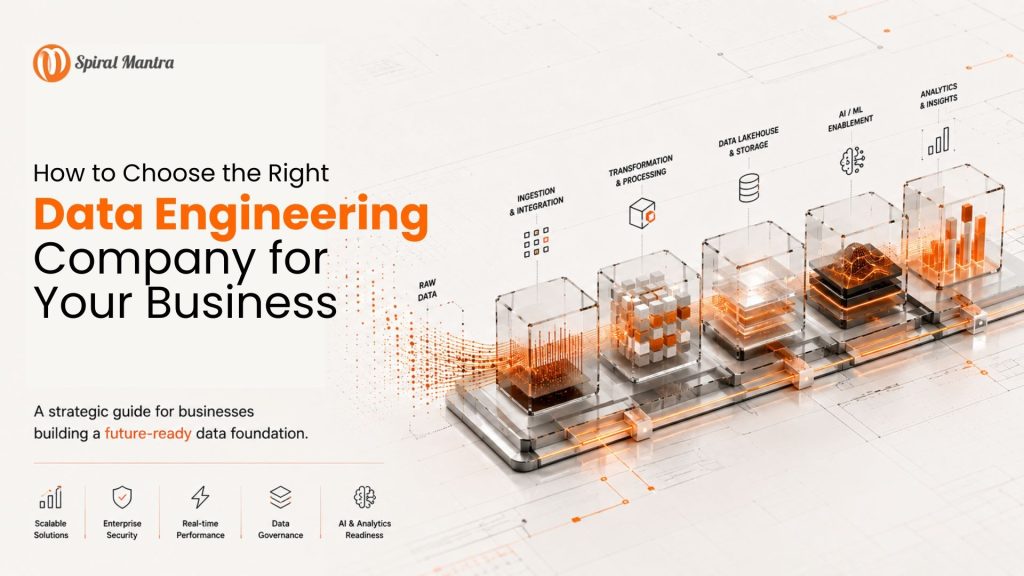
How to Choose the Right Data Engineering Company for Your Business
To choose the right data engineering company, first define your data goals, then shortlist providers with proven industry case studies, certified expertise in AWS, Azure or GCP, and modern tools like Snowflake, Databricks, dbt and Airflow. Check security and compliance practices (GDPR, HIPAA, SOC 2), ask for transparent pricing, and confirm post-deployment support before signing.
Every business today runs on data, but raw data alone doesn't create value. It needs to be collected, cleaned, structured, and made ready for analysis before it can drive real decisions. Choosing the wrong partner can mean months of wasted effort, unreliable pipelines, and reports nobody trusts. Choosing the right one can mean faster decisions, lower infrastructure costs, and a data foundation that scales with your business.This is where a Data Engineering Company plays a critical role.
Whether you're building modern analytics platforms, implementing AI solutions, migrating to the cloud, or creating real-time dashboards, the right data engineering partner can help establish a reliable and scalable foundation for your data ecosystem. However, choosing the wrong partner can result in delayed projects, poor data quality, security issues, budget overruns, and infrastructure that cannot scale with business growth.
This comprehensive guide explains exactly how to evaluate and choose the best data engineering partner for your business. You'll learn what qualifications matter, what red flags to avoid, which technologies to prioritize, and the questions every business should ask before signing a contract.
If you're searching for professional Data Engineering Services, this guide will help you make an informed decision and maximize your return on investment.
Key takeaways
- Start with your business problem, not the tech stack.
- Ask for case studies from your industry.
- Compare onshore (USA) and offshore (India) pricing models.
- Avoid vendors that push one-size-fits-all architecture.
- Insist on documentation, data governance and post-launch support.
What Does a Data Engineering Company Actually Do?
A data engineering company designs and builds the infrastructure that moves data from its source — apps, sensors, transactions, third-party APIs, into a usable, centralized form, typically a data warehouse, data lake, or lakehouse.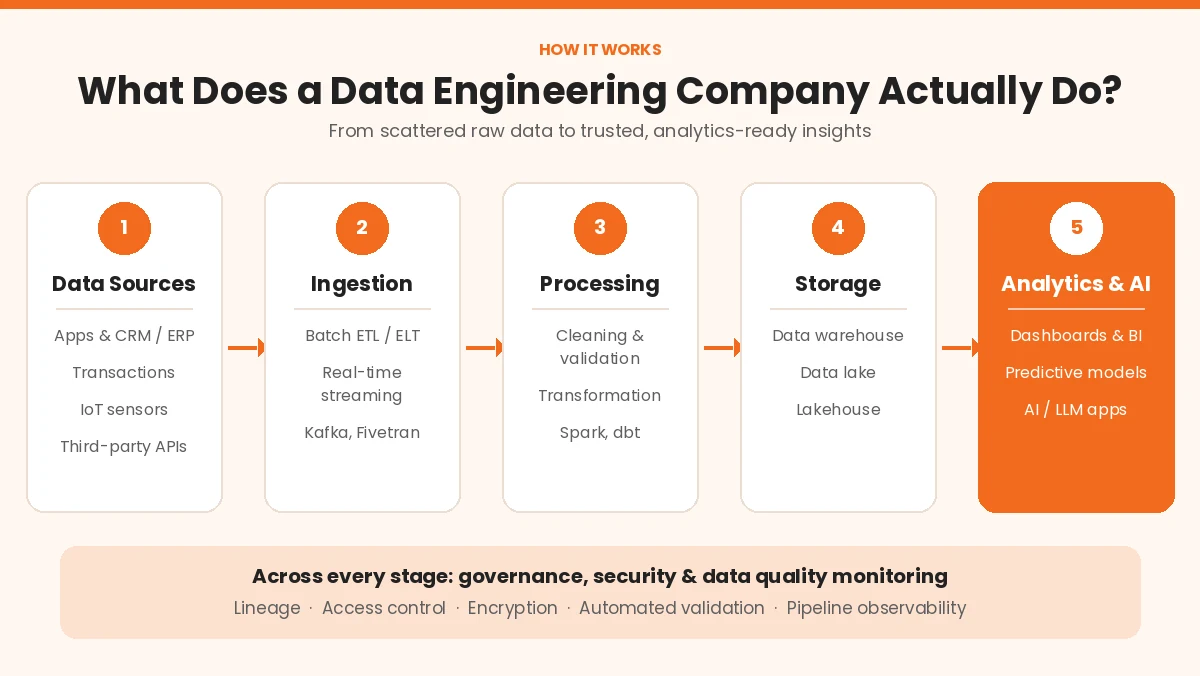 Typical responsibilities include:
- Designing scalable data architectures
- Building ETL and ELT pipelines
- Developing cloud-based data platforms
- Creating enterprise data warehouses
- Implementing modern data lakes and lakehouses
- Integrating data from multiple business applications
- Enabling real-time data streaming
- Improving data quality and governance
- Supporting AI and machine learning initiatives
Assess Your Data Needs Before Selecting a Data Engineering Partner
Before evaluating different service providers, it's essential to understand your organization's current data landscape and long-term objectives. Every business has unique requirements, and the right data consulting partner should be able to address your specific challenges rather than offering a one-size-fits-all solution. Start by naming the problem you're actually trying to solve. Is data scattered across multiple systems? Is reporting slow and dependent on manual work? Do you need to migrate to the cloud, build a modern data warehouse, or get your infrastructure ready for AI and advanced analytics? Clear answers here will define your project's scope and point you toward a partner with the right expertise. It's just as important to think ahead. As your organization grows, so will your data volume, user base, and analytics needs, the architecture you choose should scale with you, not require a rebuild every time you hit a new milestone. When assessing your requirements, focus on the following key areas:- Current Data Infrastructure: Evaluate whether your existing systems can efficiently collect, process, and store growing volumes of data or if modernization is required.
- Data Integration Requirements: Determine how data from various business applications, databases, cloud platforms, and third-party tools will be consolidated into a unified ecosystem.
- Business Objectives: Define whether your goal is to improve reporting, enable advanced analytics, support AI initiatives, enhance customer experiences, or optimize operational efficiency.
- Performance and Scalability: Consider whether your future data platform can accommodate increasing data volumes, users, and workloads without compromising performance.
- Security and Compliance: Identify any regulatory or industry-specific requirements, such as GDPR, HIPAA, or SOC 2, to ensure your data remains secure and compliant throughout its lifecycle.
Why Choosing the Right Data Engineering Company Is a Business-Critical Decision
Your data platform is one of the most valuable business assets. Every dashboard, AI model, customer insight, and executive report depends on the quality of your underlying data infrastructure. Choosing an experienced partner provides several advantages.- Better Data Quality - Poor-quality data leads to inaccurate reports, incorrect business decisions, and lost revenue. An experienced engineering team implements validation, cleansing, monitoring, and governance processes that improve data accuracy.
- Faster Decision-Making - Reliable pipelines ensure business leaders receive accurate, up-to-date information, enabling quicker and more confident decision-making.
- AI Readiness - Artificial intelligence is only as effective as the data it uses. Clean, well-structured, and governed data enables successful AI, machine learning, and predictive analytics initiatives.
- Improved Scalability - As organizations grow, data volumes increase significantly. A well-designed architecture can scale without requiring costly reengineering.
- Enhanced Security and Compliance - Professional engineering teams implement encryption, access controls, auditing, and compliance standards such as GDPR, HIPAA, SOC 2, and industry-specific regulations.
Is Your Business Ready for Professional Data Engineering Services? Signs You Shouldn't Ignore
Many organizations don't realize they have outgrown their existing data infrastructure until operational challenges begin affecting business performance. Consider investing in Data Engineering Services if you experience any of the following: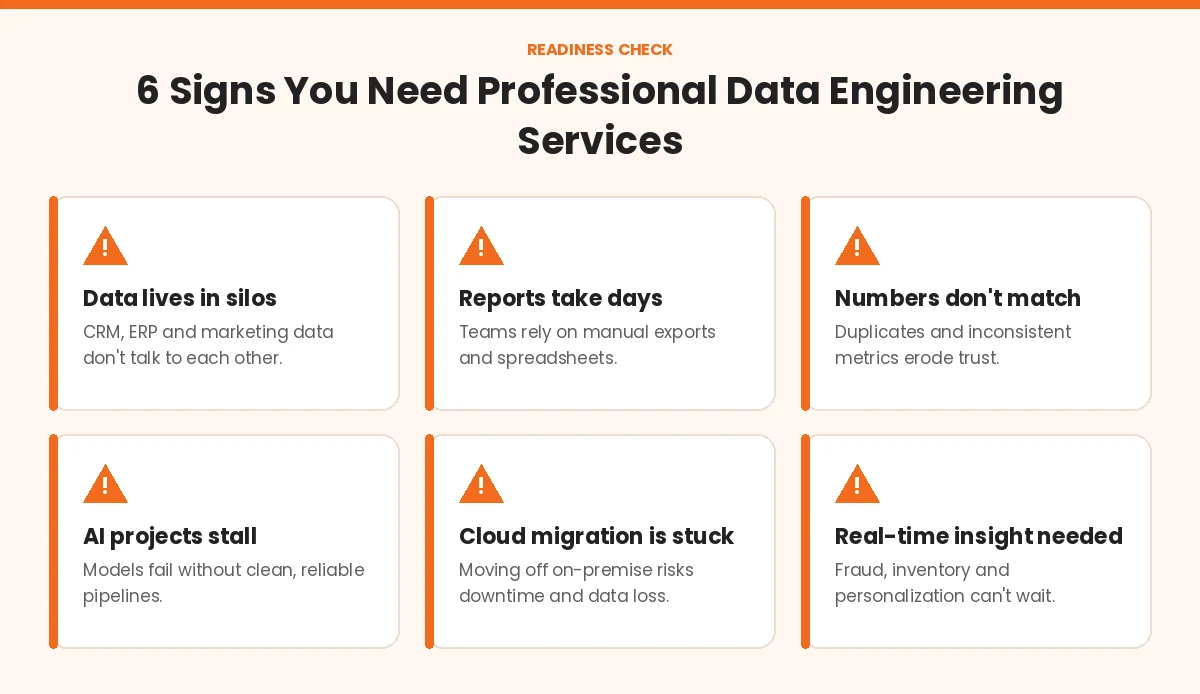
- Data Exists in Multiple Systems - Customer information, financial records, CRM data, ERP systems, marketing platforms, and operational databases are disconnected, making reporting difficult.
- Reports Take Too Long - If generating reports requires manual effort, spreadsheets, or multiple exports, your infrastructure likely needs modernization.
- Poor Data Quality - Duplicate records, inconsistent metrics, and missing information reduce confidence in business reporting.
- AI Projects Are Failing - Machine learning and generative AI initiatives depend on reliable data pipelines. Without strong engineering foundations, AI projects often struggle to deliver value.
- Cloud Migration Challenges - Migrating from on-premises infrastructure to cloud platforms requires specialized expertise to ensure minimal downtime and data integrity.
- Real-Time Analytics Requirements - Modern businesses increasingly require instant insights for fraud detection, customer personalization, inventory optimization, and operational monitoring.
Benefits of Choosing the Right Data Engineering Partner
Working with an experienced Data Engineering Company provides significant business advantages.| Business Benefit | Impact |
|---|---|
| Faster reporting | Better decision-making |
| Improved data quality | Higher accuracy |
| Cloud optimization | Lower infrastructure costs |
| AI readiness | Faster innovation |
| Better governance | Reduced compliance risks |
| Automation | Increased productivity |
| Scalable architecture | Future-proof systems |
Not All Data Engineering Companies Are the Same | Here's How They Differ
Not every provider offers the same expertise. Understanding different categories helps narrow your search.1. Full-Service Data Engineering Companies
These organizations handle end-to-end implementation, including strategy, architecture, migration, pipeline development, governance, analytics, and ongoing support. Ideal for:- Enterprises
- Digital transformation projects
- Long-term partnerships
2. Cloud Data Engineering Specialists
These firms focus on cloud-native architectures using platforms such as:- AWS
- Microsoft Azure
- Google Cloud Platform
3. Big Data Engineering Companies
These providers specialize in handling massive datasets using technologies such as:- Apache Spark
- Hadoop
- Kafka
- Flink
- Iceberg
4. AI Data Engineering Specialists
These companies design AI-ready data platforms that support:- Machine Learning
- Large Language Models (LLMs)
- Retrieval-Augmented Generation (RAG)
- MLOps
- Agentic AI workflows
Businesses looking to hire data engineers should evaluate technical expertise, experience with modern data platforms, data pipeline development skills, and knowledge of cloud technologies. Whether you need individual specialists or a complete data engineering team, choose professionals who understand your business requirements and can build secure, scalable, and reliable data solutions.
Checklist Before Hiring a Data Engineering Company
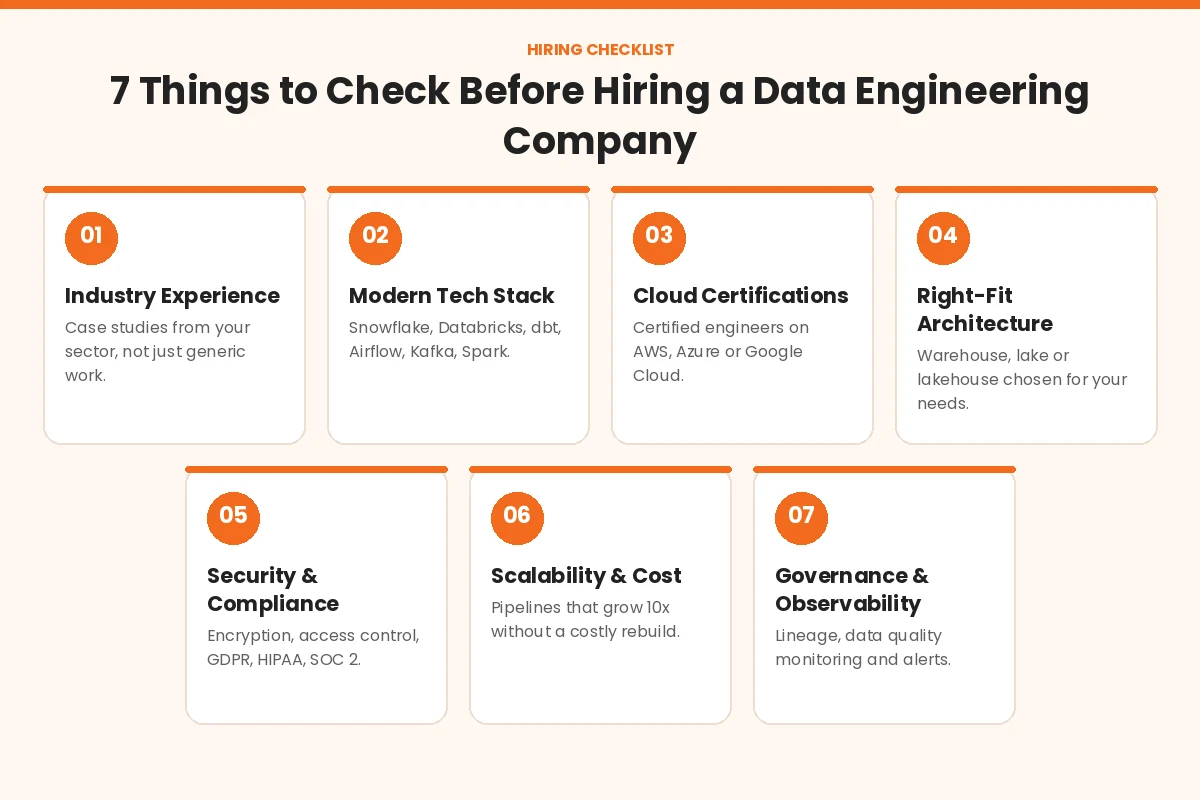
1. Industry Experience
 A team that has built pipelines for retail inventory forecasting will approach problems differently than one that's worked in healthcare claims processing. Ask for case studies or references from your specific industry, the regulatory requirements, data volume patterns, and business logic vary significantly across sectors.
For example:
A team that has built pipelines for retail inventory forecasting will approach problems differently than one that's worked in healthcare claims processing. Ask for case studies or references from your specific industry, the regulatory requirements, data volume patterns, and business logic vary significantly across sectors.
For example:
- Healthcare organizations require HIPAA compliance.
- Financial institutions prioritize governance and fraud detection.
- Manufacturing companies need IoT integration and predictive maintenance.
- Retail businesses focus on customer analytics and inventory optimization.
- Industry knowledge reduces implementation time and improves solution quality.
2. Technical Expertise and Toolset
Evaluate whether the company has experience with modern technologies rather than relying on outdated tools. Look for expertise in:- Apache Spark
- Snowflake
- Databricks
- Microsoft Fabric
- dbt
- Apache Airflow
- Kafka
- Delta Lake
- Apache Iceberg
- SQL
- Python
- Terraform
- Kubernetes
3. Cloud Platform Certifications
Cloud expertise has become essential for modern data engineering. Ask whether the company holds certifications in:- AWS
- Microsoft Azure
- Google Cloud Platform
4. Future-Proof Data Architecture
A strong partner should recommend the most appropriate architecture based on your business needs. Examples include:- Data Warehouse
- Data Lake
- Lakehouse Architecture
- Data Mesh
- Data Fabric
- Hybrid Cloud Architecture
5. Security and Compliance
Data security should be integrated into every stage of engineering. Key capabilities include:- Role-based access control
- Encryption at rest and in transit
- Identity management
- Data masking
- Audit logging
- Compliance reporting
- Backup and disaster recovery
6. Scalability and Performance
Your business may generate ten times more data within a few years. Ask potential partners:- Can the architecture scale automatically?
- How do you optimize pipeline performance?
- How do you minimize cloud costs?
- How do you monitor resource utilization?
7. Data Governance and Observability
Modern organizations require more than just pipelines. Leading data engineering companies now implement:- Data lineage
- Metadata management
- Data cataloging
- Data quality monitoring
- Data observability
- Data contracts
- Automated validation
- Pipeline health dashboards
Common Mistakes Businesses Make When Choosing a Data Engineering Partner
Many organizations focus solely on cost, overlooking critical factors that determine long-term success. Some of the most common mistakes include:- Choosing the lowest-priced vendor without evaluating technical capabilities.
- Ignoring industry-specific experience.
- Overlooking cloud and AI expertise.
- Failing to assess security and compliance practices.
- Not asking for client references or case studies.
- Selecting a partner that lacks post-deployment support.
- Assuming all data engineering companies offer the same services.
How Data Engineering Supports Data Analytics
High-quality data analytics services rely on strong data engineering to:- Collect reliable data
- Standardize information
- Remove inconsistencies
- Build trusted datasets
- Deliver real-time dashboards
- Enable predictive analytics
- Support AI and machine learning