How to Choose the Best AI Development Company in the USA (2026)
Key Takeaways
- Define a clear business problem and measurable success criteria before contacting vendors.
- Evaluate technical expertise, relevant project experience, data security, and integration capabilities.
- Compare complete project costs, including infrastructure, model usage, maintenance, and support.
- Ask for a detailed proposal, transparent deliverables, and clear intellectual property terms.
- Use a vendor scorecard to compare shortlisted companies consistently.
- Start with a well-defined pilot before investing in a larger AI implementation.
What Does an AI Development Company Do?
An AI development company helps businesses plan, build, integrate, deploy, and maintain software solutions that use artificial intelligence. Depending on the project, these services may include machine learning, generative AI applications, AI agents, natural language processing, computer vision, workflow automation, and data-driven applications.Rather than simply providing access to an AI model, a development partner connects the technology to real business processes. This may involve preparing data, integrating existing software, evaluating model performance, implementing security controls, and monitoring the solution after deployment.Common AI development services include:- Custom AI development: Building software around specific business requirements.
- Generative AI development: Creating applications that generate or summarize text, analyze documents, or assist employees.
- Machine learning development: Developing predictive models, classification systems, and recommendation engines.
- AI agent development: Building systems that can perform defined tasks using tools, business rules, and appropriate human oversight.
- RAG implementation: Connecting language models to relevant business information to support more grounded responses.
- AI integration: Connecting AI capabilities with CRMs, ERPs, databases, websites, and mobile applications.
- AI deployment and maintenance: Monitoring performance, managing updates, and improving reliability over time.
7 Expert Tips for Choosing an AI Development Company in the USA
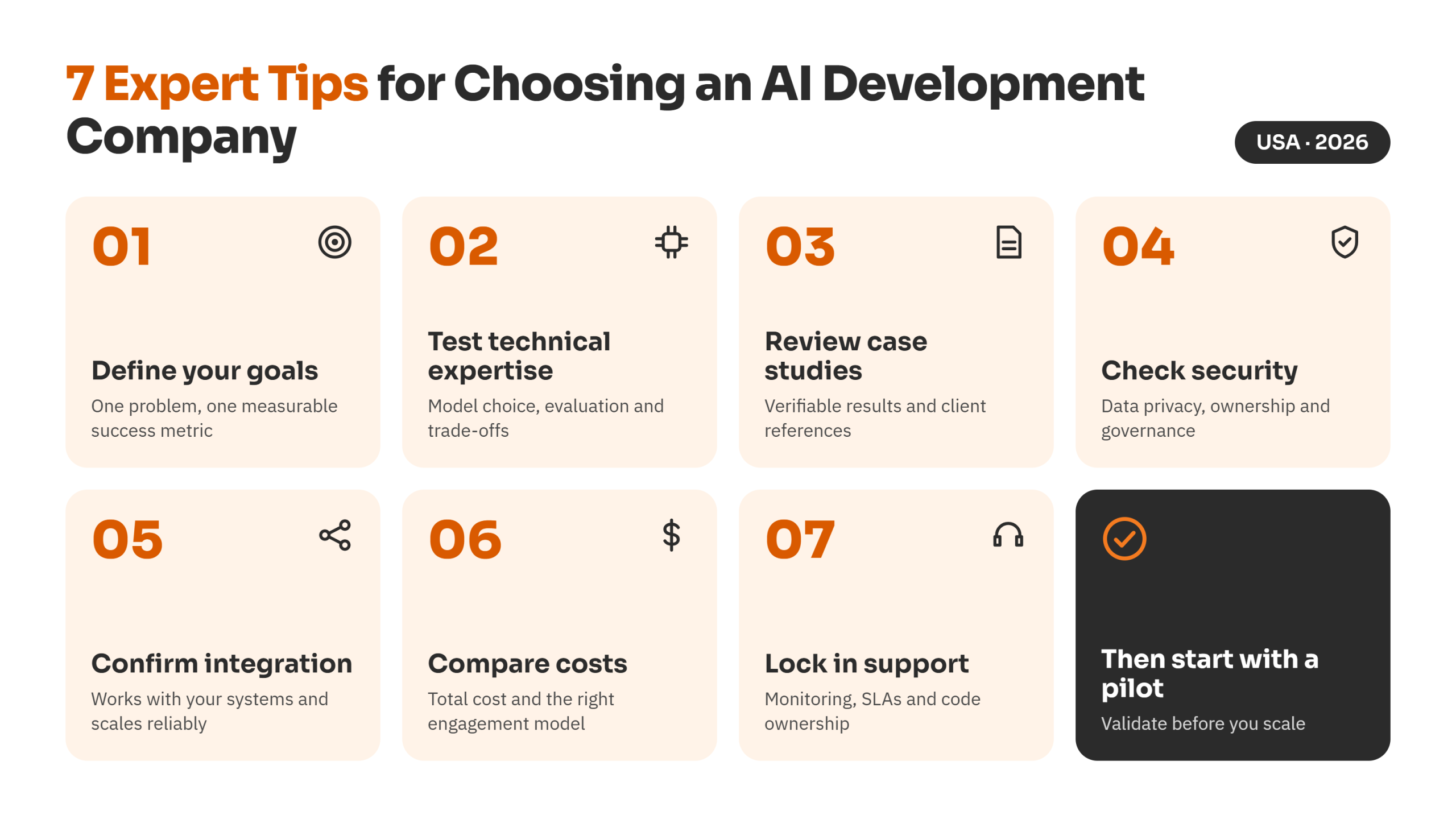
1. Define Your Business Goals Before Comparing Vendors
Start with your business problem rather than a particular AI technology. Identify the process you want to improve, the people who will use the solution, and the outcome you expect.For example, your business may want to reduce manual document processing, improve customer support response times, forecast demand more accurately, or help employees find information across internal documents.Translate that goal into measurable success criteria.| Business objective | Example success metric |
| Automate document processing | Reduce average processing time |
| Improve customer support | Reduce response time while maintaining answer quality |
| Improve demand forecasting | Measure forecast error against a baseline |
| Help employees find information | Measure answer relevance and task completion |
| Automate repetitive workflows | Track manual effort saved and error rates |
2. Evaluate Technical Expertise and Problem-Solving Ability
A capable AI development team should understand how to select, implement, test, and maintain the right approach for your use case.Depending on your project requirements, you may need expertise in machine learning, generative AI, natural language processing, computer vision, or AI integration. If your project requires specialized model development, training, deployment, or optimization, working with experienced machine learning experts can help you evaluate suitable approaches and build solutions aligned with your business objectives. You do not necessarily need a custom-trained AI model. An existing model or API may be sufficient for some applications, while other projects may require fine-tuning, retrieval systems, specialized models, or a combination of approaches.Ask prospective vendors these questions:- How would you determine which AI approach fits our requirements?
- How will you evaluate accuracy, relevance, reliability, and safety?
- How will the system handle incorrect, incomplete, or ambiguous inputs?
- What happens when an AI model or third-party API becomes unavailable?
- How will you monitor performance and manage ongoing costs?
3. Review Case Studies and Verifiable Results
A portfolio can help you understand whether a company has experience with problems similar to yours. However, a list of technologies or attractive screenshots is not enough to establish delivery capability.Look for case studies that explain the original business problem, the solution implemented, the integration requirements, the challenges encountered, and the outcomes measured.Useful evidence may include:- Reduced processing time or manual effort.
- Improved model evaluation results.
- Faster application response times.
- Better workflow completion rates.
- Reduced operational costs, where supported by actual measurements.
- Successful integration with existing business systems.
4. Check Data Security, Privacy, and AI Governance
AI applications may process confidential documents, customer information, employee records, financial data, or proprietary business knowledge. Security and privacy should therefore be part of vendor evaluation from the beginning.Ask the AI development company how it will protect data throughout development, testing, deployment, and maintenance.Important considerations include:- Data access: Who can access your data, and under what conditions?
- Encryption: How will information be protected during transmission and storage?
- Data retention: How long will your information be retained, and how will it be deleted?
- Third-party models: Will submitted data be processed by external providers? Can it be used for model training under the applicable service terms?
- Ownership: Who owns the source code, custom components, documentation, and project-specific intellectual property?
- Testing: What security assessments and vulnerability checks will be performed?
- Incident response: How will security incidents be identified, communicated, and handled?
- Human oversight: Which decisions require review or approval by a person?
5. Confirm Integration, Scalability, and Reliability
An AI demonstration may work well in isolation but fail to deliver business value if it cannot integrate reliably with existing systems.Before choosing a vendor, identify the applications, databases, APIs, and workflows the solution must support. Depending on your business, these may include a CRM, ERP, internal knowledge base, website, mobile application, or data warehouse.Discuss the following requirements:- Existing system compatibility and API availability.
- Expected users, request volumes, and response times.
- Authentication, authorization, and access permissions.
- Data synchronization and data quality.
- Error handling, retries, and fallback behavior.
- Testing, logging, monitoring, and incident management.
- Backup, recovery, and rollback procedures.
- Infrastructure capacity and expected operating costs.
6. Compare AI Development Costs and Engagement Models
The cost of hiring an AI development company in the USA depends on project scope, data readiness, model selection, integrations, security requirements, testing, and ongoing maintenance.A simple AI API integration is different from a custom machine learning platform or an enterprise AI application that processes sensitive information across multiple systems.These are illustrative planning ranges.| Project type | Illustrative cost range(USD) | Illustrative timeline |
| Proof of concept | 15,000–40,000 | 3–6 weeks |
| Production AI feature | 40,000–120,000 | 2–4 months |
| Custom AI product | 120,000–300,000+ | 4–9 months |
What Affects AI Development Costs?
When reviewing a proposal, check whether it includes:- Discovery, planning, and requirements analysis.
- Data collection, preparation, cleaning, and validation.
- Model selection, customization, or fine-tuning.
- RAG implementation and vector database infrastructure, if required.
- Software development and third-party integrations.
- Cloud hosting, model API usage, and storage.
- Security assessments, testing, and evaluation.
- Deployment, monitoring, and documentation.
- Maintenance, support, and future improvements.
Which Engagement Model Should You Choose?
- Fixed-price project: Suitable when requirements, deliverables, and acceptance criteria are clearly defined.
- Time-and-materials engagement: Useful when requirements may change during development and flexibility is important.
- Dedicated development team: May suit long-term projects that need ongoing engineering capacity and continuous improvements.
- Discovery or paid pilot: Helpful when the business problem is understood but technical feasibility, data readiness, or expected performance remains uncertain.
7. Confirm Post-Launch Support and Long-Term Ownership
AI development does not end when an application goes live. Data can change, third-party models can be updated, integrations can fail, and usage costs can increase.Before signing a contract, establish what support the vendor will provide after launch.Discuss:- Monitoring and performance reporting.
- Bug fixes and security patches.
- Model and prompt evaluation.
- Data-quality checks and drift monitoring, where relevant.
- Infrastructure and API cost optimization.
- Response times and service-level agreements (SLAs).
- Documentation and knowledge transfer.
- Source-code access and ownership terms.
- Exit arrangements and transition support.
Also Read: Custom AI Development vs. Off-the-Shelf AI: Which Is the Smarter Investment for Your Enterprise?
What Services Should You Look for in an AI Development Company?
Not every business needs the same AI capabilities. Use your business objectives to determine which services matter most.| Business requirement | Potential service |
| Forecasting, classification, or recommendations | Machine learning development |
| Document summarization or content generation | Generative AI development |
| Searching internal company knowledge | RAG and enterprise search |
| Automating defined multi-step tasks | AI agent development or workflow automation |
| Extracting information from images | Computer vision and document processing |
| Preparing data for analytics or AI models | Data engineering |
| Connecting AI to existing software | AI integration and application development |
| Operating and improving a deployed solution | AI deployment, monitoring, and maintenance |
Data Engineering for AI Readiness
AI applications depend on reliable, well-organized data. A company offering data engineering services can help businesses build data pipelines, integrate information from multiple sources, and prepare data for AI development and machine learning workflows.What Does the AI Development Process Look Like?
Understanding the development process helps you evaluate proposals and establish realistic expectations.A typical AI project may include the following stages.- Discovery and requirements: Define the business problem, intended users, constraints, and success metrics.
- Data assessment: Review data availability, quality, permissions, privacy requirements, and preparation needs.
- Feasibility and proof of concept: Test whether the proposed approach can meet the most important requirements before committing to a larger build.
- Design and development: Build the application, connect required systems, and implement the chosen AI capabilities.
- Testing and evaluation: Assess output quality, reliability, security, performance, and failure handling using representative scenarios.
- Deployment: Release the solution in a controlled manner, with appropriate access controls, monitoring, and rollback plans.
- Monitoring and improvement: Review actual performance, operating costs, user feedback, and changing business requirements.
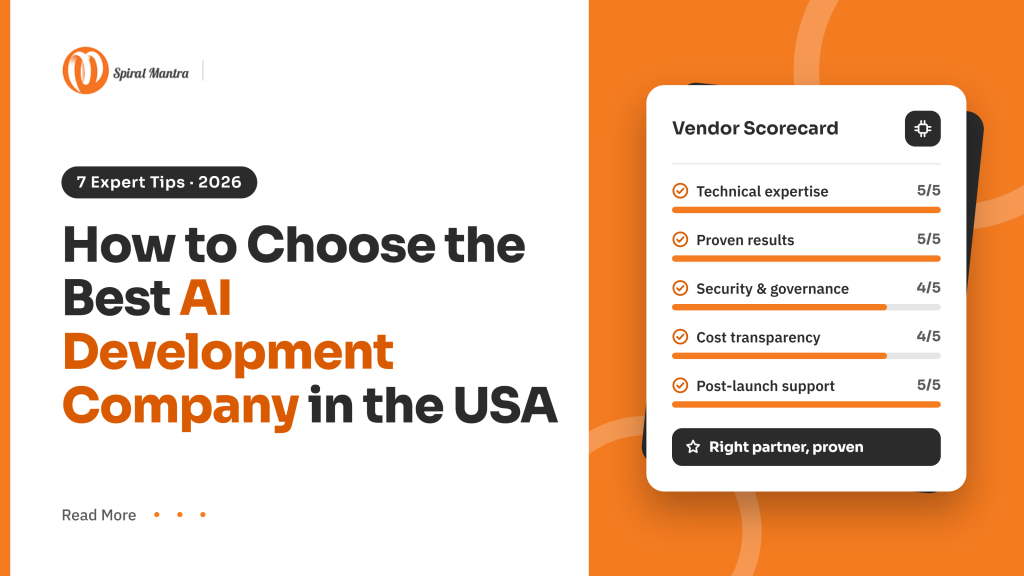
AI Development Company Evaluation Scorecard
Use a consistent scorecard to compare shortlisted vendors. Score each criterion from 1 to 5, where 1 means weak evidence and 5 means strong evidence.| Evaluation criterion | Weight |
| Business understanding and requirements | 15% |
| Technical expertise and evaluation approach | 20% |
| Relevant project experience and results | 20% |
| Security, privacy, and governance | 15% |
| Integration and scalability | 10% |
| Cost transparency | 10% |
| Post-launch support and documentation | 10% |
| Total | 100% |
Questions to Ask Before Hiring an AI Development Company
Before making a decision, ask each shortlisted company the same core questions:- Have you delivered a project with requirements similar to ours?
- How will you measure the success and reliability of the proposed solution?
- Which data, integrations, and third-party services will the project require?
- Where will our data be processed, and how will it be protected?
- What will the project cost to build, operate, and maintain?
- Who will work on the project, and can we meet the delivery team?
- What testing, documentation, and knowledge transfer will be provided?
- Who owns the code and project-specific intellectual property?
- What happens if the proposed approach fails to meet the agreed acceptance criteria?
- What support is available after launch?
Red Flags to Watch For
Be cautious if a vendor:- Guarantees 100% AI accuracy or promises that hallucinations are impossible.
- Recommends a technology before understanding your business problem.
- Cannot explain its testing and evaluation methods.
- Gives vague answers about data security or intellectual property.
- Omits recurring infrastructure, API, or maintenance costs.
- Promises delivery without accounting for data preparation and integration.
- Refuses to define deliverables or acceptance criteria.
- Provides no clear post-launch support plan.
How Spiral Mantra Can Help With AI Development
Choosing the right AI development partner starts with understanding your business objectives, data, existing systems, and long-term requirements. Spiral Mantra provides AI-related technology services for businesses exploring custom AI solutions.Depending on your project, this may involve developing an AI application, integrating AI with existing software, preparing data for AI workflows, or planning deployment and ongoing support.Before starting a project, define the problem you want to solve, establish measurable success criteria, and evaluate the technical and operational requirements. A well-scoped initial engagement can help your business assess feasibility before committing to a larger implementation.Planning an AI project?
Explore [Spiral Mantra's AI Development Services] or contact the team to discuss your business requirements.Frequently Asked Questions (FAQs)
Q1. How do I choose the best AI development company in the USA?
Compare relevant project experience, technical expertise, security practices, integration capabilities, measurable results, total costs, and post-launch support. Ask each shortlisted vendor the same questions and validate its claims with references, demonstrations, or documented evidence.
Q2. How much does it cost to hire an AI development company in the USA?
The cost depends on project scope, data readiness, model selection, integrations, security, and maintenance. Preliminary estimates may range from tens of thousands of dollars for a proof of concept to several hundred thousand dollars or more for a complex custom AI product. Request an itemized quote and verify all estimates against your requirements.
Q3. How long does an AI development project take?
A proof of concept may take several weeks, while a production-ready solution can take several months. Timelines depend on data quality, integrations, testing requirements, stakeholder availability, and project complexity.
Q4. What services does an AI development company provide?
Services may include custom AI applications, generative AI, machine learning, AI agents, RAG, computer vision, workflow automation, data engineering, software integration, deployment, and ongoing maintenance.
Q5. Should I hire an AI development company or build an in-house team?
Outsourcing may suit businesses that need specialized skills, want to test an idea, or need to accelerate delivery. An in-house team may be preferable when AI is central to the product and the company needs long-term internal ownership. Some businesses begin with an external partner and gradually build internal capabilities.
Q6. What is the difference between generative AI and traditional machine learning?
Generative AI creates or transforms content, such as text, images, summaries, or code. Traditional machine learning is often used for prediction, classification, anomaly detection, and recommendations. The best approach depends on the task, available data, evaluation requirements, and business goals.
Q7. What should an AI development proposal include?
A proposal should describe the scope, deliverables, milestones, team responsibilities, technical approach, data requirements, acceptance criteria, security provisions, intellectual property terms, infrastructure costs, testing, and post-launch support.
Q8. How can I verify an AI development company's credibility?
Review relevant case studies, check whether results are supported by evidence, request client references, meet the engineers responsible for delivery, and assess the company's security practices, documentation, and support arrangements.