Choosing the Best AI Solution for Your Business Growth
AI is no longer a futuristic concept—it's a core driver of digital transformation, reshaping how businesses automate tasks, gain predictive insights, and improve customer experience. But adopting AI isn't just about picking the latest technology; it's about choosing the right approach: Custom AI Development or an Off-the-Shelf AI solution.
Pre-built platforms are quick to deploy and budget-friendly, while custom solutions offer flexibility, scalability, and precision for complex challenges.
So which is right for your enterprise?
It depends on your goals, industry, data maturity, and long-term strategy. This guide compares both approaches—costs, benefits, and real-world use cases—to help you decide.
Why AI Investment Is Accelerating Across Industries
According to recent industry reports, organizations are increasing their investment in AI because it helps them:
Improve operational efficiency
Reduce manual and repetitive work
Deliver personalized customer experiences
Enhance decision-making through predictive analytics
Optimize supply chains
Detect fraud and security threats
Increase employee productivity
Create innovative products and services
Whether it's a retailer using AI to recommend products, a hospital improving diagnostics, or a manufacturer predicting equipment failures, AI is becoming a strategic business asset rather than just another technology tool.
As AI adoption grows, enterprises are realizing that choosing the right implementation approach is just as important as choosing AI itself.
Understanding Custom AI Development
Custom AI development means building an AI system from the ground up around your organization's specific data, workflows, and business outcomes — instead of adapting your business to fit a generic tool. It typically involves proprietary model fine-tuning, custom retrieval architectures, secure data pipelines, and integrations with your existing tech stack (ERP, CRM, legacy databases, and internal tools).
Partnering with an experienced AI Development Company allows enterprises to design AI systems that reflect exactly how their teams operate, rather than forcing operations to conform to a vendor's assumptions about "the average business."
Custom AI is typically:Built on your proprietary data and business logic
Designed for deep integration with internal systems
Owned entirely by your organization (no vendor lock-in)
Scalable and adaptable as your workflows evolve
Aligned with specific compliance and data-residency requirements
What Is Off-the-Shelf AI?
Off-the-shelf AI refers to pre-built, subscription-based tools — think generic chatbots, AI writing assistants, or plug-and-play copilots — designed to serve a broad range of users with minimal setup. They're fast to deploy and require little technical investment upfront.
Off-the-shelf AI is typically:Ready to use within days, sometimes hours
Lower upfront cost, priced per user/month
Designed for common, repeatable use cases (support tickets, content drafts, basic Q&A)
Limited in customization and deep system integration
Subject to the vendor's roadmap, pricing changes, and data policies
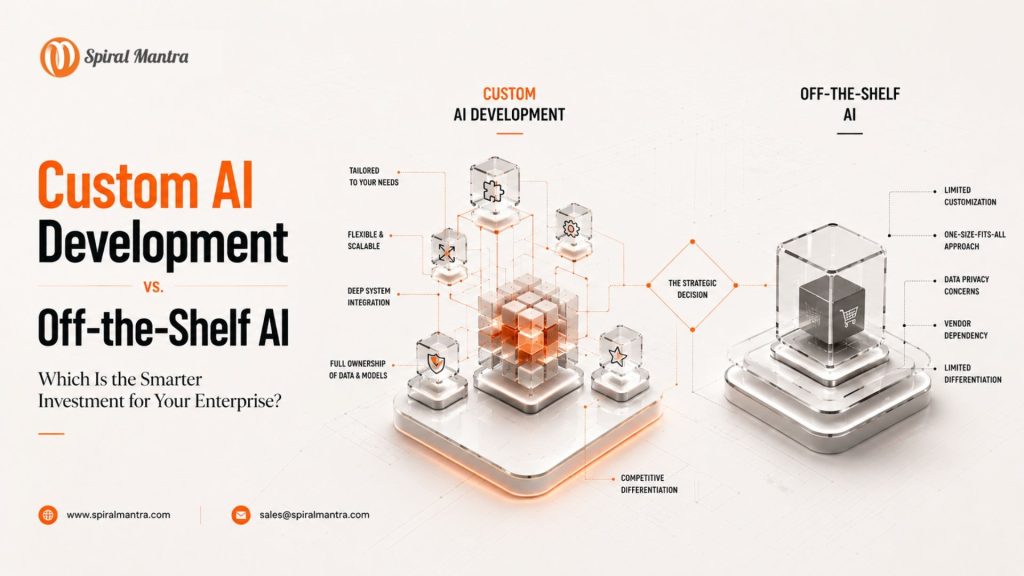
Custom AI vs Off-the-Shelf AI: Side-by-Side Comparison
| Factor | Custom AI Development | Off-the-Shelf AI |
|---|---|---|
Setup Time |
Weeks to months |
Days to weeks |
Upfront Cost |
Higher initial investment |
Low initial investment |
Long-Term Cost (TCO) |
Often lower at scale |
Recurring per-user fees add up |
Customization |
Fully tailored to workflows |
Limited, template-based |
Data Ownership |
Full control and ownership |
Vendor-controlled, shared infrastructure |
Integration Depth |
Deep integration with legacy systems |
Surface-level or API-limited |
Scalability |
Grows with your business |
Often hits a functionality ceiling |
Competitive Differentiation |
High — proprietary advantage |
Low — same tool as competitors |
The Biggest Advantages of Custom AI Development
Built Around Your Business, Not the Other Way Around - Every organization has unique workflows, customer journeys, and operational challenges. Custom AI solutions are designed to fit your existing business processes instead of forcing employees to adapt to software limitations.
A Long-Term Competitive Advantage - One of the biggest drawbacks of off-the-shelf AI is that your competitors can access the same tools. If every company in your industry uses identical AI software, it's difficult to stand out. Custom AI, on the other hand, becomes a strategic business asset. It leverages your proprietary data, processes, and expertise to create capabilities that competitors cannot easily replicate.
Better Integration with Enterprise Systems - Modern enterprises rely on multiple platforms, including CRM systems, ERP software, cloud infrastructure, HR tools, and data warehouses. Custom AI solutions can integrate seamlessly with these systems, enabling data to flow securely across departments.
You need quick deployment.
Your AI requirements are relatively standard.
Budget constraints are significant.
You're exploring AI for the first time.
Your team needs productivity enhancements rather than business transformation.
AI is central to your competitive strategy.
Your organization relies on proprietary business processes.
You want to automate complex workflows.
Customer experience is a key differentiator.
Data security and compliance are critical.
Long-term scalability matters.
Assist doctors with diagnostic insights
Predict patient readmissions
Optimize appointment scheduling
Analyze medical imaging
Automate clinical documentation
Fraud detection
Credit risk analysis
Customer service automation
Personalized financial recommendations
Regulatory compliance monitoring
Personalized product recommendations
Demand forecasting
Inventory optimization
Dynamic pricing
Customer segmentation
Marketing automation
Predict equipment failures
Optimize production schedules
Improve quality control
Reduce downtime
Enhance supply chain planning
Optimize delivery routes
Predict shipment delays
Improve warehouse efficiency
Forecast transportation demand
Reduce fuel consumption
A SaaS startup wants AI to summarize meeting notes and assist employees with writing emails.
A ready-made AI platform like Microsoft Copilot or ChatGPT Enterprise is likely sufficient.
Developing a custom AI platform would add unnecessary complexity.
A healthcare network wants AI to analyze patient histories, identify high-risk cases, and integrate directly with electronic health records.
Because of strict compliance requirements and specialized workflows, custom AI development services is the better option.
A retailer wants AI to recommend products based on years of customer purchase history while integrating with inventory systems.
Although recommendation engines exist commercially, a custom AI model trained on proprietary customer data can significantly improve conversion rates.
Is this workflow unique to us, or common across every business in our industry?
Does this involve sensitive, proprietary, or regulated data?
Will this AI system need to integrate deeply with our internal tools?
Are we optimizing for speed today, or cost and control over the next three years?
Could this become a genuine competitive advantage if we owned it outright?
Scheduling meetings
Processing invoices
Monitoring business operations
Making routine decisions based on predefined policies
Create content
Write code
Summarize documents
Generate reports
Interact with customers
Marketing
Human Resources
Finance
Legal
Customer Support
Explainable AI Models
Data Privacy
Bias Detection & Mitigation
Regulatory Compliance
Human Oversight for Critical Decisions
Deliver customized product recommendations
Personalize marketing campaigns
Predict customer needs
Improve customer support
Increase customer loyalty
Sales
Marketing
Customer Support
Supply Chain Management
Human Resources
Finance
Product Development
AI Development Services
AI Development Company
Generative AI Development
AI Automation Solutions
Machine Learning Development
AI Consulting & Strategy
Custom AI Applications
AI Integration with Enterprise Systems
Intelligent Workflow Automation
Custom AI vs. Off-the-Shelf AI: Which Delivers Better ROI?
The return on investment depends on how AI contributes to your organization's strategic objectives.
Off-the-Shelf AI Delivers Better ROI When:
Custom AI Delivers Better ROI When:
Rather than asking, "Which option is cheaper?", enterprises should ask:
"Which option creates the greatest business value over the next five years?"
Industry Use Cases: Where Custom AI Creates the Biggest Impact
Healthcare
Healthcare organizations generate massive volumes of clinical and operational data every day.
Custom AI helps hospitals and healthcare providers:
These applications require specialized AI models trained on healthcare-specific datasets—something generic tools typically cannot provide.
Financial Services
Banks and financial institutions rely on AI for:
Since financial fraud patterns vary between organizations, custom AI models often outperform generic solutions.
Retail & E-commerce
Retailers use AI to improve every stage of the customer journey.
Examples include:
Companies with unique customer behavior data gain a significant competitive advantage through custom AI.
Manufacturing
Manufacturers increasingly use AI to:
Computer vision systems built specifically for factory environments often achieve much higher accuracy than generalized AI tools.
Logistics & Supply Chain
AI enables logistics companies to:
Since logistics operations differ significantly between businesses, customized AI solutions typically provide superior results.
Real-World Business Scenarios
Scenario 1: A Growing StartupHow to Decide: A Quick Framework
Ask these questions before committing either way:
If most answers point toward complexity, compliance, or differentiation — custom AI development is worth the investment. If the workflow is standard and low-risk, off-the-shelf AI will likely serve you well.
Can Enterprises Combine Both Approaches?
Absolutely.
In fact, many leading organizations adopt a hybrid AI strategy, combining the strengths of both approaches.
The Future of Enterprise AI
Artificial Intelligence is evolving rapidly. The AI strategy that works today may need to adapt tomorrow as new technologies and business demands emerge. Organizations investing in AI should look beyond immediate gains and prepare for the next wave of innovation.
Here are some of the key trends shaping the future of enterprise AI.
1. Agentic AI: Autonomous AI SystemsThe next generation of AI won't just answer questions—it will take action.
Agentic AI systems can autonomously perform tasks such as:
For enterprises, this means moving from simple automation to intelligent, goal-oriented workflows that require minimal human intervention.
2. Generative AI Becomes a Business StandardGenerative AI is transforming how organizations:
Rather than replacing employees, Generative AI is becoming a productivity accelerator across departments including:
Businesses that integrate Generative AI into their workflows today are likely to gain a significant competitive advantage in the coming years.
3. AI Governance & Responsible AIAs AI adoption grows, organizations must ensure their systems are transparent, secure, and ethical.
Future AI strategies will place greater emphasis on:
Building responsible AI is no longer optional—it's essential for maintaining customer trust and meeting evolving regulations.
4. Hyper-Personalized Customer ExperiencesCustomers increasingly expect businesses to understand their preferences and deliver personalized experiences.
AI enables organizations to:
Custom AI solutions trained on proprietary business data are particularly effective at delivering these personalized experiences.
5. AI as a Core Business CapabilityForward-thinking organizations are no longer treating AI as an isolated IT initiative. Instead, they're embedding AI into every aspect of their operations, including:
Enterprises that integrate AI across business functions are better positioned to innovate, improve efficiency, and respond quickly to changing market demands.
Why Partner with Spiral Mantra for AI Development?
Choosing the right AI approach is only part of the equation. The success of your AI initiative also depends on selecting an experienced technology partner who understands your business goals.
At Spiral Mantra, we specialize in delivering intelligent, scalable, and business-focused AI solutions that solve real-world challenges—not just technical problems.
Our team combines expertise in data engineering, machine learning, cloud technologies, and enterprise software development to build AI systems that integrate seamlessly into your existing business processes.
Our Capabilities Include:
Whether you're implementing AI for the first time or modernizing an existing solution, we help you create AI systems that are secure, scalable, and aligned with your long-term business objectives.
Final Thoughts
The "custom vs. off-the-shelf" debate isn't about picking a side permanently—it's about matching the right approach to the right workflow at the right stage of your enterprise's AI maturity.
Off-the-shelf tools remain a smart entry point for common tasks. But when AI needs to become core to your operations—secure, deeply integrated, and genuinely differentiating—custom development is what delivers lasting ROI.
Working with a proven AI Development Company helps enterprises avoid the common trap of overpaying for generic tools that plateau, or underbuilding a custom system that can't scale. Contact Spiral Mantra, we will help you map your workflows first and recommend a path second—not the other way around.
People Also Ask (FAQs)
1. What is the main difference between custom AI development and off-the-shelf AI?
Custom AI is built specifically around your organization's data, workflows, and compliance needs, while off-the-shelf AI is a pre-built, general-purpose tool designed to serve many businesses with minimal setup.
2. Is custom AI development worth the investment?
Yes. Businesses that require advanced automation, enterprise-grade security, seamless integrations, or proprietary AI capabilities often achieve greater long-term ROI through custom AI development.
3. Which industries benefit the most from custom AI solutions?
Healthcare, finance, manufacturing, retail, logistics, insurance, education, and technology companies often benefit significantly because they have complex workflows, regulatory requirements, and large volumes of business-specific data.
4. Can small businesses use off-the-shelf AI successfully?
Absolutely. Off-the-shelf AI is an excellent starting point for small and medium-sized businesses that want to automate routine tasks, improve productivity, or explore AI capabilities without significant upfront investment.
5. How do I know if my business needs custom AI?
If your organization has unique workflows, requires integration with multiple enterprise systems, handles sensitive data, or plans to use AI as a strategic business capability, custom AI development is likely the better choice.
6. Why should I choose Spiral Mantra as my AI development partner?
Spiral Mantra combines deep technical expertise with a business-first approach to deliver secure, scalable, and future-ready AI solutions. From AI strategy and consulting to custom development, integrations, and ongoing support, our team helps enterprises maximize the value of their AI investments.