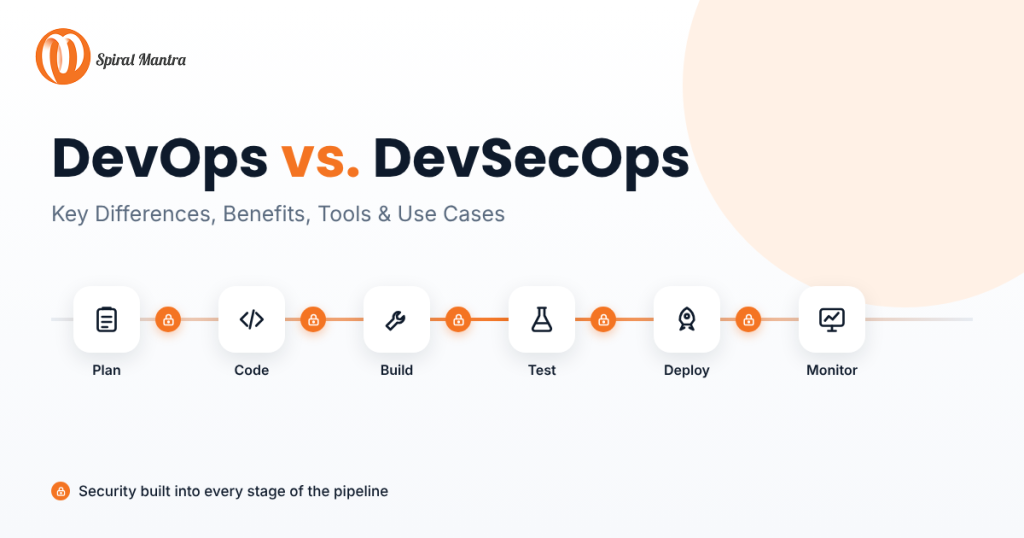
DevOps vs. DevSecOps: Key Differences, Benefits, Tools & Use Cases
Imagine your development team releases a new software feature in two days instead of two weeks. The CI/CD pipeline runs successfully, customers are satisfied, and your business is moving forward. However, a security alert reveals that an outdated open-source library used in the application contains a known vulnerability.
This situation highlights an important challenge for modern businesses: delivering software quickly is not enough. Applications must also be reliable, scalable, and secure.
This is where the DevOps vs DevSecOps comparison becomes important. Both approaches improve software delivery, but they address different priorities.
DevOps brings development and IT operations teams together to automate workflows, improve collaboration, and deliver software more efficiently. DevSecOps extends DevOps by integrating security practices into every stage of the software development lifecycle (SDLC), helping organizations identify and address vulnerabilities earlier.
The main difference is that DevOps emphasizes collaboration, automation, and reliable software delivery, while DevSecOps combines these practices with continuous security and risk management.
Neither approach is universally better. The right choice depends on your business objectives, application architecture, data sensitivity, infrastructure, and security requirements.
For CTOs, CIOs, and business owners evaluating technology investments, understanding these differences can help determine the right software delivery strategy. Professional DevOps Consulting Services can also help organizations assess existing workflows, identify technical gaps, and implement an approach aligned with their long-term goals.
In this guide, we explore the differences between DevOps and DevSecOps, their business benefits, popular tools, practical use cases, implementation challenges, and how to choose the right approach.
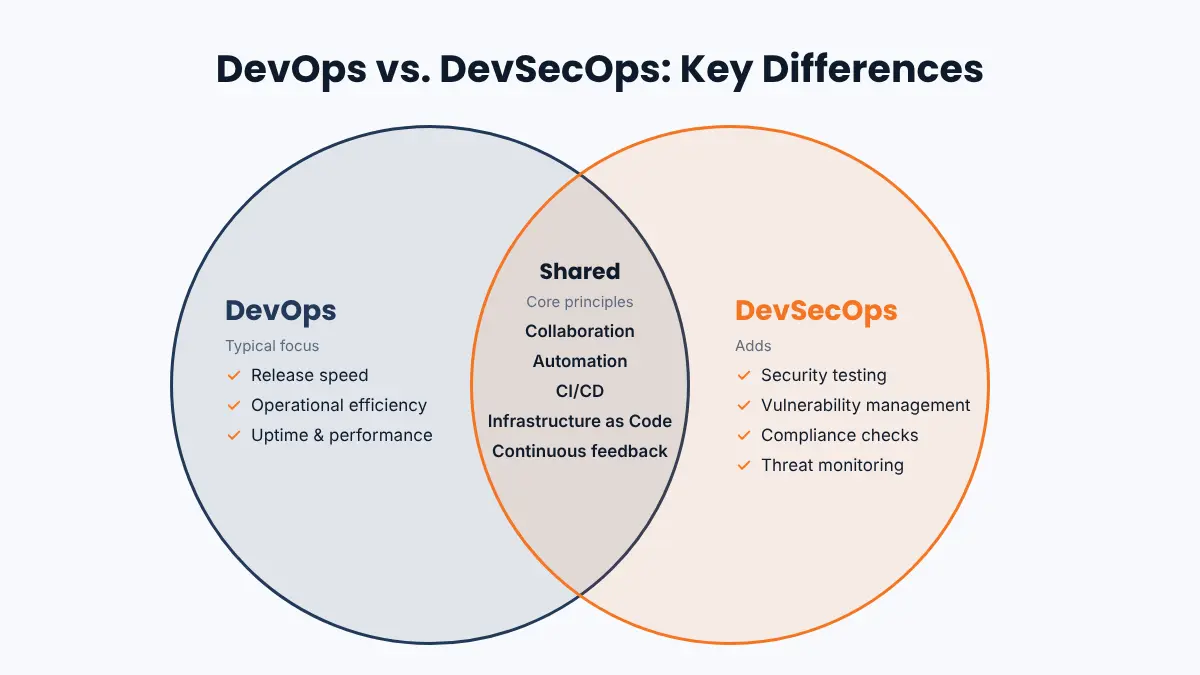 DevOps and DevSecOps share several principles, including collaboration, automation, continuous integration, and continuous delivery. Their main difference is the level of security integration throughout the software delivery lifecycle.
DevOps focuses on improving development and operational workflows, whereas DevSecOps makes continuous security an integral part of those workflows.
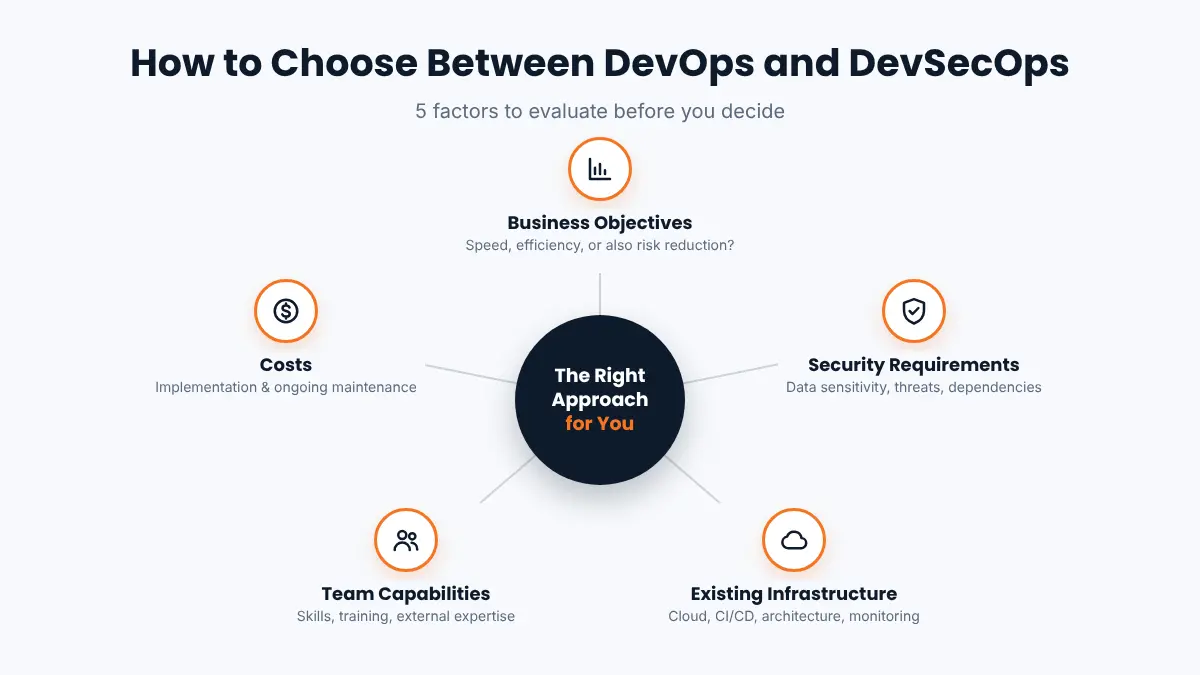 Consider these five factors before making a decision.
What is DevOps?
DevOps is a software development methodology and organizational culture that combines development (Dev) and IT operations (Ops) to improve collaboration and streamline software delivery. Traditionally, developers were responsible for writing application code, while operations teams managed deployment, infrastructure, and application availability. This separation often created communication gaps, deployment delays, and inconsistent environments. DevOps addresses these challenges through shared responsibility, automation, continuous integration, continuous delivery, and ongoing feedback. Instead of treating development and operations as separate activities, DevOps encourages teams to work together throughout the software development lifecycle.How Does the DevOps Lifecycle Work?
DevOps follows a continuous lifecycle that connects planning, development, testing, deployment, operations, and monitoring.Its major stages include:
- Plan: Define business requirements, prioritize features, and establish development objectives.
- Code: Developers write, review, and manage application code using version control systems such as Git.
- Build and Integrate: Continuous Integration (CI) automatically builds and tests code changes as they are integrated into shared repositories.
- Test: Automated unit, integration, functional, and performance tests help identify application issues.
- Release and Deploy: Continuous Delivery and Deployment (CD) workflows prepare and release validated software.
- Operate: Teams manage infrastructure, application availability, and scalability.
- Monitor and Improve: Monitoring tools collect performance information and operational feedback to guide future improvements.
Key Benefits of DevOps
- Faster software delivery: Automated pipelines help teams release updates more efficiently.
- Improved collaboration: Shared ownership reduces communication gaps between development and operations.
- Operational efficiency: Infrastructure automation reduces repetitive manual activities.
- Scalable infrastructure: Cloud platforms such as AWS, Microsoft Azure, and Google Cloud support flexible infrastructure management.
- Better reliability: Automated testing, monitoring, and controlled deployment strategies help identify issues earlier.
What is DevSecOps?
DevSecOps stands for Development, Security, and Operations. It extends DevOps by integrating security practices into every stage of the software development and delivery lifecycle. In traditional software development environments, security testing was sometimes performed near the end of development or immediately before production deployment. This approach could allow vulnerabilities to remain undetected until later stages. DevSecOps addresses this challenge by making security a shared responsibility among developers, security professionals, and operations teams. It incorporates automated security testing, vulnerability management, access controls, and security monitoring into existing development and deployment workflows.What is Shift-Left Security?
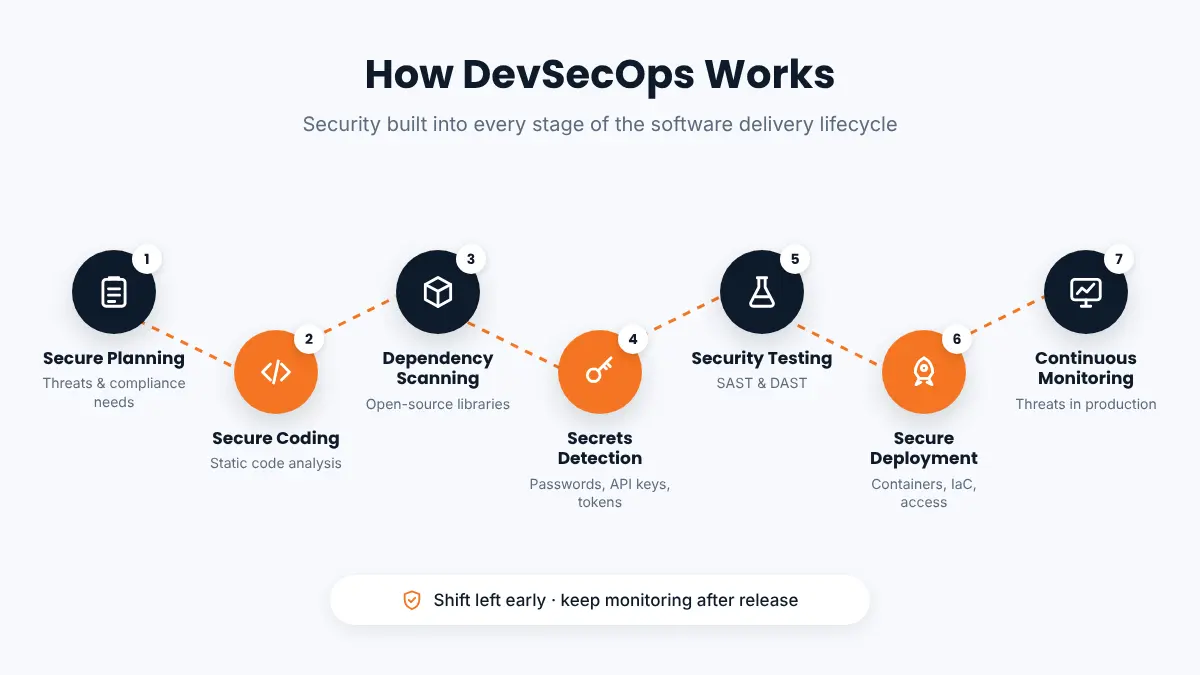
Shift-left security means identifying and addressing security issues as early as possible in the software development lifecycle. For example, instead of waiting until an application is ready for production, developers can use automated tools to scan source code, dependencies, and configurations during development. DevSecOps also includes security monitoring after deployment, ensuring that production applications and infrastructure continue to be evaluated for potential risks.How Does DevSecOps Work?
A typical DevSecOps workflow includes:- Secure Planning: Identify security requirements, potential threats, and applicable compliance considerations.
- Secure Coding: Follow secure coding practices and use static analysis to identify potential vulnerabilities.
- Dependency Scanning: Check third-party libraries and open-source components for known vulnerabilities.
- Secrets Detection: Identify exposed passwords, API keys, and authentication tokens.
- Security Testing: Perform Static Application Security Testing (SAST) and Dynamic Application Security Testing (DAST).
- Secure Deployment: Validate container images, Infrastructure as Code configurations, and access permissions.
- Continuous Monitoring: Monitor applications and infrastructure for suspicious activity and newly discovered vulnerabilities.
Key Benefits of DevSecOps
- Earlier identification of application vulnerabilities.
- Improved management of third-party dependencies.
- Better visibility into software supply chain risks.
- Stronger collaboration between development, security, and operations teams.
- More consistent security validation across deployment workflows.
- Improved support for security governance and compliance activities.
DevOps vs. DevSecOps: Key Differences
DevOps and DevSecOps share several principles, including collaboration, automation, continuous integration, and continuous delivery. Their main difference is the level of security integration throughout the software delivery lifecycle.
DevOps focuses on improving development and operational workflows, whereas DevSecOps makes continuous security an integral part of those workflows.
DevOps vs. DevSecOps Comparison Table
| Comparison Factor | DevOps | DevSecOps |
| Primary focus | Development and operations collaboration | Development, security, and operations collaboration |
| Main objective | Faster and more reliable software delivery | Secure, reliable, and efficient software delivery |
| Security approach | Security is addressed through organizational controls and development processes | Security is systematically integrated into delivery workflows |
| Team responsibilities | Developers and operations teams | Developers, security professionals, and operations teams |
| Testing | Functional, integration, and performance testing | DevOps testing plus automated security testing |
| CI/CD pipeline | Automates building, testing, and deployment | Adds security checks and policy enforcement |
| Vulnerability management | May use separate security workflows | Integrates vulnerability detection and remediation |
| Compliance | Supported through organizational processes | Can incorporate automated security and policy checks |
| Monitoring | Performance, availability, and reliability | Performance, availability, and security monitoring |
| Business outcome | Improved delivery efficiency | Improved delivery efficiency with stronger security integration |
Five Important Differences Explained
1. Security Integration
DevOps workflows automate application building, testing, and deployment. DevSecOps adds security checks to these processes. For example, a DevSecOps pipeline may scan application code, third-party dependencies, and container images before allowing a production deployment.2. Team Responsibilities
DevOps encourages developers and operations engineers to share responsibility for application delivery. DevSecOps extends this collaboration to security professionals, ensuring that security requirements are considered throughout development and deployment.3. Testing and Automation
DevOps commonly automates functional, integration, and performance testing. DevSecOps includes these activities alongside additional security testing methods, such as SAST, DAST, Software Composition Analysis (SCA), and Infrastructure as Code scanning.4. Risk and Compliance Management
DevOps improves delivery consistency but does not automatically provide comprehensive security assurance. DevSecOps can help organizations implement security controls that support requirements associated with frameworks and regulations such as SOC 2, ISO/IEC 27001, HIPAA, and PCI DSS. However, automated tools alone do not establish compliance. Appropriate governance, documentation, risk management, and audits are also necessary.5. Business Priorities
DevOps primarily helps organizations improve delivery speed, collaboration, and operational efficiency. DevSecOps combines these objectives with continuous security validation and risk management.Popular DevOps and DevSecOps Tools
Selecting the right tools is essential for building effective development, deployment, and security workflows. The best technology stack depends on your existing infrastructure, cloud platform, development environment, team expertise, and business requirements.Popular DevOps Tools
| Tool | Primary Purpose |
| Jenkins | Automates CI/CD pipelines and software builds |
| GitHub Actions | Automates development and deployment workflows |
| GitLab CI/CD | Supports continuous integration and delivery |
| Docker | Packages applications into containers |
| Kubernetes | Automates container deployment and orchestration |
| Terraform | Automates infrastructure provisioning through IaC |
| Ansible | Supports configuration management and automation |
| Azure DevOps | Provides repositories, planning, testing, and CI/CD capabilities |
Popular DevSecOps Tools
| Tool | Primary Purpose |
| SonarQube | Identifies code quality issues and potential security vulnerabilities |
| Snyk | Scans application dependencies, code, containers, and IaC |
| OWASP ZAP | Performs dynamic web application security testing |
| Trivy | Scans containers, repositories, and configurations for vulnerabilities |
| Checkov | Identifies security and compliance misconfigurations in IaC |
| GitHub Advanced Security | Provides code scanning, secret scanning, and dependency security capabilities |
How Should Businesses Select the Right Tools?
Before investing in new tools, organizations should evaluate:- Compatibility with existing development platforms.
- Integration with CI/CD pipelines.
- Cloud infrastructure requirements.
- Security testing and vulnerability detection capabilities.
- Licensing and operational costs.
- Reporting and monitoring features.
- Team expertise and maintenance requirements.
Real-World Business Use Cases: DevOps vs. DevSecOps
Both methodologies support modern software development, but their applications can vary depending on the organization's industry, infrastructure, and risk profile.DevOps Use Cases
1. SaaS Application Development
SaaS businesses frequently release product improvements and application updates. DevOps automation helps streamline builds, testing, and deployments while supporting continuous product development.2. E-Commerce Platforms
E-commerce businesses regularly update product catalogs, payment integrations, and customer-facing features. DevOps helps coordinate releases and manage infrastructure as traffic demands change.3. Cloud Migration
Organizations migrating legacy applications to AWS, Azure, or Google Cloud can use Infrastructure as Code and CI/CD automation to establish consistent deployment environments.4. Enterprise Application Modernization
Large organizations can use DevOps to improve collaboration across distributed engineering teams, automate testing, and standardize application deployment.DevSecOps Use Cases
1. Financial Services and FinTech
Financial applications handle sensitive information and transactions. DevSecOps can integrate dependency scanning, access controls, security testing, and monitoring into software delivery workflows.2. Healthcare Applications
Healthcare platforms may process sensitive patient information. DevSecOps practices help integrate security validation and monitoring into application development and deployment.3. Enterprise Cloud Platforms
Organizations managing complex cloud environments can use security scanning to identify infrastructure misconfigurations, exposed secrets, and vulnerable workloads.4. Software Products Using Open-Source Components
Companies using third-party libraries can implement Software Composition Analysis and Software Bill of Materials (SBOM) management to understand and manage software supply chain risks.How to Choose Between DevOps and DevSecOps?
Choosing the right approach requires understanding your business priorities, existing technical environment, and security responsibilities.
Consider these five factors before making a decision.
1. Identify Your Business Objectives
If your main challenges involve manual deployments, slow releases, and operational inefficiencies, DevOps can provide a strong foundation. If your organization also needs continuous vulnerability detection, security testing, and stronger risk management, consider integrating DevSecOps practices.2. Evaluate Your Security Requirements
Assess the sensitivity of your application data, potential threats, third-party dependencies, and applicable security obligations. Businesses managing financial information, healthcare data, intellectual property, or enterprise applications may benefit from more comprehensive security integration.3. Assess Your Existing Infrastructure
Review your current cloud platforms, CI/CD pipelines, application architecture, repositories, and monitoring systems. This assessment can reveal which automation and security capabilities need improvement.4. Consider Your Team's Technical Capabilities
Successful implementation requires collaboration between developers, operations engineers, and security professionals. Evaluate your team's existing skills and identify where additional training, technical resources, or external expertise may be required.5. Calculate Implementation and Maintenance Costs
Your investment may include:- Cloud infrastructure and hosting.
- CI/CD platform configuration.
- Security scanning tools.
- Infrastructure automation.
- Monitoring and logging.
- Engineering and consulting resources.
- Training and onboarding.
- Ongoing maintenance and optimization.
How DevOps Consulting Services Help Businesses Improve Software Delivery
Implementing DevOps requires more than installing automation tools. Organizations need a suitable strategy, infrastructure architecture, CI/CD workflows, monitoring capabilities, and continuous improvement processes. Professional DevOps Consulting Services can help businesses evaluate their existing technology environments and identify opportunities to improve software delivery. An experienced DevOps consulting company can support several important areas:- DevOps Assessment and Strategy: Evaluate existing development and operational workflows to identify technical gaps and automation opportunities.
- CI/CD Implementation: Design automated pipelines for application building, testing, and deployment.
- Infrastructure as Code: Automate infrastructure provisioning and configuration using tools such as Terraform and Ansible.
- Cloud Migration and Optimization: Improve cloud infrastructure across AWS, Microsoft Azure, and Google Cloud.
- Containerization and Orchestration: Implement Docker and Kubernetes to support application portability and scalable deployments.
- Azure DevOps Implementation: Configure repositories, pipelines, deployment environments, and automated testing workflows.
- Monitoring and Optimization: Improve application performance, infrastructure visibility, and operational reliability.
- DevSecOps Integration: Where included in the engagement, incorporate appropriate security scanning and validation into existing delivery workflows.
Can DevOps and DevSecOps Work Together?
Yes. DevOps and DevSecOps are complementary approaches rather than competing methodologies. DevSecOps builds upon the collaborative and automated foundation of DevOps by integrating security practices into existing development and deployment workflows. Organizations do not necessarily need to replace their existing CI/CD pipelines to introduce DevSecOps. For example, a business using Jenkins, GitHub Actions, GitLab CI/CD, or Azure Pipelines can gradually introduce:- Static code analysis during development.
- Dependency vulnerability scanning during builds.
- Secrets detection before code is merged.
- Container image scanning before deployment.
- Infrastructure configuration validation.
- Security monitoring after production deployment.
Common Challenges Businesses Should Consider
Although DevOps and DevSecOps offer several advantages, implementation can introduce technical and organizational challenges.- Toolchain Complexity: Too many disconnected tools increase maintenance requirements and fragment workflows.
- Skills Gaps: Teams may require additional training in cloud infrastructure, automation, and application security.
- Legacy Applications: Older applications may require architectural improvements before supporting modern automation practices.
- Integration Difficulties: Connecting repositories, cloud platforms, security tools, and monitoring systems requires careful planning.
- Pipeline Performance: Poorly configured security checks can increase build times and slow down development.
- Organizational Resistance: Teams accustomed to separate responsibilities may need time to adopt shared ownership.